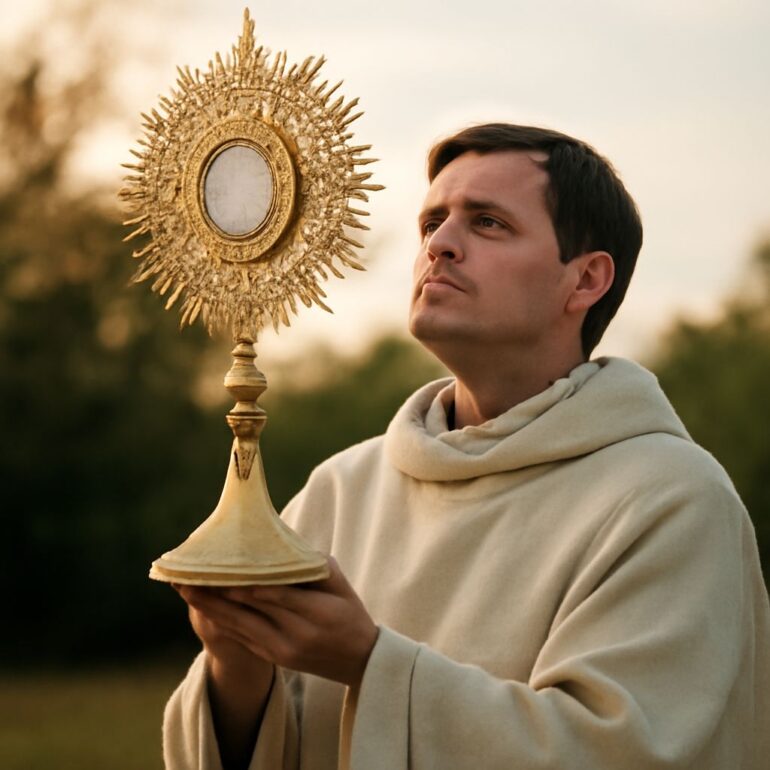
What do Catholics believe? Catholics believe in one God, revealed as the Trinity, and in Jesus Christ, who became human, died, and rose from the dead. They believe God offers salvation by grace and continues to form and nourish believers through the Church and its sacraments.
A concise account also needs two distinctions: Catholic faith draws on both Scripture and Sacred Tradition, and Catholic moral teaching distinguishes mortal sin from venial sin by three conditions. The meaning of Catholic identity and these beliefs becomes clearer below.
What Does the Word Catholic Mean?
In plain language, what does the word Catholic mean? Catholic means “universal.” The term comes from a Greek word meaning “according to the whole,” or complete. It points to a faith intended for all peoples and places, not to one ethnicity, language, or nation.
In common use, Catholic refers to the Catholic Church, whose members are united in faith, worship, and communion with the bishop of Rome. Local customs may differ, but this shared communion gives Catholic Christianity a worldwide identity.
What Do Catholics Believe?
At the center of Catholic belief are these teachings:
- One God in three persons. The Trinity is the Father, the Son, and the Holy Spirit: three distinct persons who share one divine nature.
- Jesus Christ. Catholics believe Jesus is the Son of God, fully divine and fully human. Through his incarnation, death, and resurrection, he opens the way to reconciliation with God.
- Grace. Grace is God’s free gift, given through Christ. It enables people to believe, live in holiness, and share in eternal life; it is not something people can earn by their own efforts.
- Scripture and Tradition. The Bible and Sacred Tradition together transmit the Christian faith. The Church’s teaching office, called the Magisterium, interprets them.
- The Church. Catholics describe the Church as one, holy, catholic, and apostolic. Bishops, united with the pope, continue the ministry handed on from the apostles.
- Sacramental life. Catholics recognize seven sacraments: Baptism, Confirmation, the Eucharist, Reconciliation, Anointing of the Sick, Holy Orders, and Matrimony. These visible signs communicate God’s grace, with the Eucharist holding a central place in Catholic worship.
What Is Mortal Sin?
A common question—what is mortal sin?—has a specific answer in Catholic teaching: it is a grave offense against God that destroys charity in the heart and turns a person away from him. For a sin to be mortal, all three conditions must be present.
- Grave matter. The act must concern something seriously wrong. Catholic teaching looks to the Ten Commandments and the Gospel to identify such matters, which can include murder, adultery, or serious theft.
- Full knowledge. The person must understand that the act is seriously sinful, not merely know that it breaks a rule.
- Deliberate consent. The person must freely choose the act. It cannot be merely accidental or imposed without meaningful freedom.
Fear, force, habit, immaturity, or serious psychological pressure can reduce a person’s responsibility. An act may involve grave matter without being a mortal sin if full knowledge or deliberate consent is absent.
Venial sin differs because the matter is less serious, or because full knowledge or deliberate consent is missing. It harms a person’s friendship with God but does not destroy it in the way mortal sin does.
Because mortal sin breaks communion with God, Catholic practice calls for repentance and sacramental confession. Catholics who are conscious of mortal sin ordinarily receive the Sacrament of Reconciliation before receiving the Eucharist.
