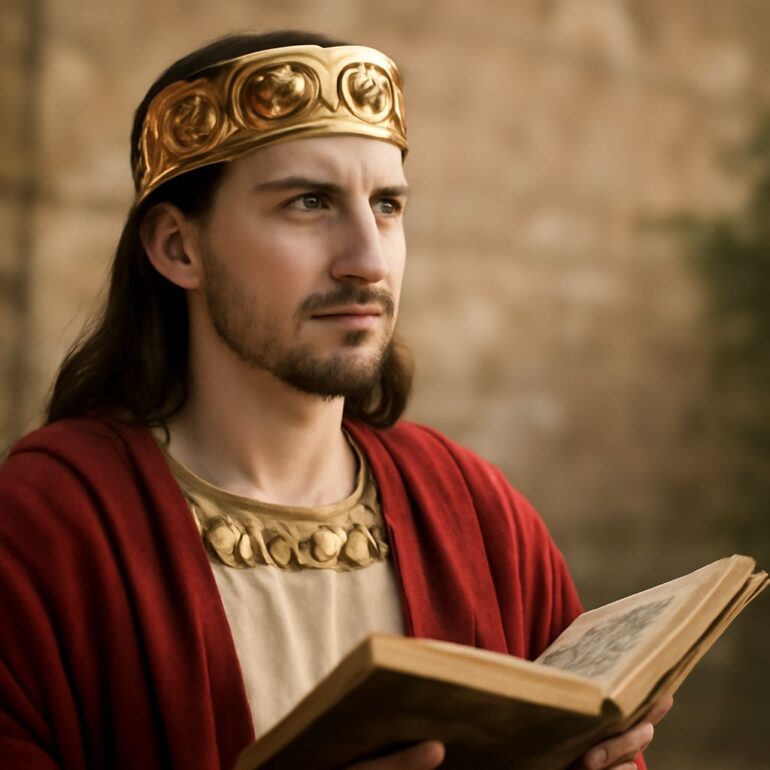
Who was Josiah in the Bible? He was a king of Judah whom the biblical books of Kings and Chronicles associate with the repair of Jerusalem’s Temple, the discovery of a book of the law, and a far-reaching religious reform. The accounts also describe his death after an encounter with the Egyptian ruler Neco.
The Judean ruler’s story in Scripture brings together royal power, priestly institutions, prophetic counsel, and public worship. Its details are preserved in narrative accounts written with theological purposes; their claims and the historical evidence for the reforms need to be considered separately.
Josiah Bible accounts: where to begin
The principal Josiah Bible accounts appear in 2 Kings 22–23 and 2 Chronicles 34–35. The links lead to the first chapter of each account; the following chapter completes each story. Kings emphasizes the discovery of the law book and the king’s response, while Chronicles presents its own sequence and gives a fuller account of the Passover and the king’s final campaign.
The two works are related but should not be treated as interchangeable transcripts. Each author selects and arranges material to explain Judah’s history. A reader can compare the passages on the Temple, the law, and the ruler’s death, noting what each says before combining details from them.
The accounts place the reign in the late seventh century BCE, when the small kingdom of Judah faced changing power relationships among larger states. They do not offer a modern biography or a complete administrative archive. Their portrait is especially interested in a ruler’s obligations to God and the community.
A child on Judah’s throne
According to 2 Kings 21:23–24, officials killed King Amon, and the people of the land killed the conspirators and made his son king. 2 Kings 22:1–2 says the new ruler was eight years old when he began to reign and ruled for thirty-one years in Jerusalem. It evaluates him favorably by comparison with David.
The age at accession raises questions about how government operated during his childhood, but the narrative does not identify a complete regency or explain every decision made on his behalf. It does name officials and priests later involved in the Temple work. Their presence shows that royal action in the account depended on an institutional network, not on the king acting alone.
The setting matters for understanding king Josiah in the Bible: Judah had its own court and Temple, but it lived amid the ambitions of larger powers. The account of a reforming king unfolds alongside that political vulnerability. It is not a story of a community insulated from regional events.
The law book and Huldah’s response
In the eighteenth year of the reign, Kings reports that the king ordered the collection of funds for repairs to the Temple. The high priest Hilkiah says he has found a book of the law there. Shaphan the scribe brings the report and reads the book to the king, who tears his garments and sends a delegation to inquire of the Lord.
The delegation consults Huldah, a prophetess in Jerusalem. In 2 Kings 22:14–20, she announces judgment on Judah for its conduct while also conveying a response to the king’s humbled reaction. Her role is central to the story: an authoritative interpretation of the discovery comes through a woman identified as a prophet, rather than from the court or priesthood alone.
Scholars have often connected the discovered book with Deuteronomy or an earlier form of it, partly because of similarities between the reform narrative and Deuteronomy’s concern for worship. That is an interpretation of the evidence, not a title supplied by the account itself. A review in the Journal of Hebrew Scriptures describes both the common association and scholarly questions about how directly the texts should be linked.
Covenant, worship, and the Passover
2 Kings 23 describes a public reading of the book, followed by the king’s commitment to a covenant before the Lord and the people’s participation. A covenant here is a binding relationship expressed through obligations. The text then recounts the removal or destruction of objects and places associated with practices the narrative condemns.
The account includes actions at sites outside Jerusalem and describes a Passover observance. Its writers present these measures as an exceptional return to the law. They also record force and destruction: the narrative is not merely an account of private spiritual renewal. The treatment of rival religious practices reflects the text’s particular perspective and the power of a king over institutions and sacred places.
Chronicles organizes related events differently. 2 Chronicles 34 places a campaign against illicit worship earlier in the reign, before the account of Temple repair and the discovery of the book. Chapter 35 devotes substantial attention to the Passover’s organization. These differences help readers see each work’s priorities and caution against assuming that every event is presented in exactly the same order.
What archaeology can and cannot establish
Material remains can illuminate worship and settlement in ancient Judah, but identifying a destroyed altar or altered sanctuary with one specific royal order is difficult. Dates, the cause of a site’s change, and the reach of a policy may all be disputed. An archaeological site and a biblical narrative therefore need to be assessed together, with attention to the limits of each kind of evidence.
A scholarly overview of the archaeological debate discusses sites such as Arad and Beersheba in relation to reported reforms under Judean kings. The existence of a potential parallel does not by itself prove every action or the full geographic extent described in Kings. Scholars differ over how the remains should be dated and interpreted.
Likewise, the biblical writers offer theological judgments as well as historical claims. Their praise of the king tells readers what the authors considered faithful rule; it does not settle every question about the policy’s implementation. A careful account identifies a claim as the text’s and avoids treating either a single discovery or the absence of one as a complete reconstruction of the reign.
The encounter with Egypt and its aftermath
Kings reports that Pharaoh Neco went north toward the Euphrates and that the king of Judah went to meet him. According to 2 Kings 23:29–30, Neco killed him at Megiddo, and his servants brought his body to Jerusalem for burial. The account is brief about the encounter and does not explain every political motive.
2 Chronicles 35:20–24 gives a fuller battle narrative: the king is wounded by archers, taken to Jerusalem, and dies there. The accounts agree on an encounter with Neco and the ruler’s death but differ in the details they supply about his final moments. Chronicles also describes mourning for him, including lament by Jeremiah.
The death left a succession crisis in a region where Egypt and other powers could exert influence over Judah. Kings continues with the reigns of his sons and Egyptian intervention. Reading beyond the reform shows that the text’s strongly favorable portrait of one ruler sits within a larger, troubled account of the kingdom’s future.
