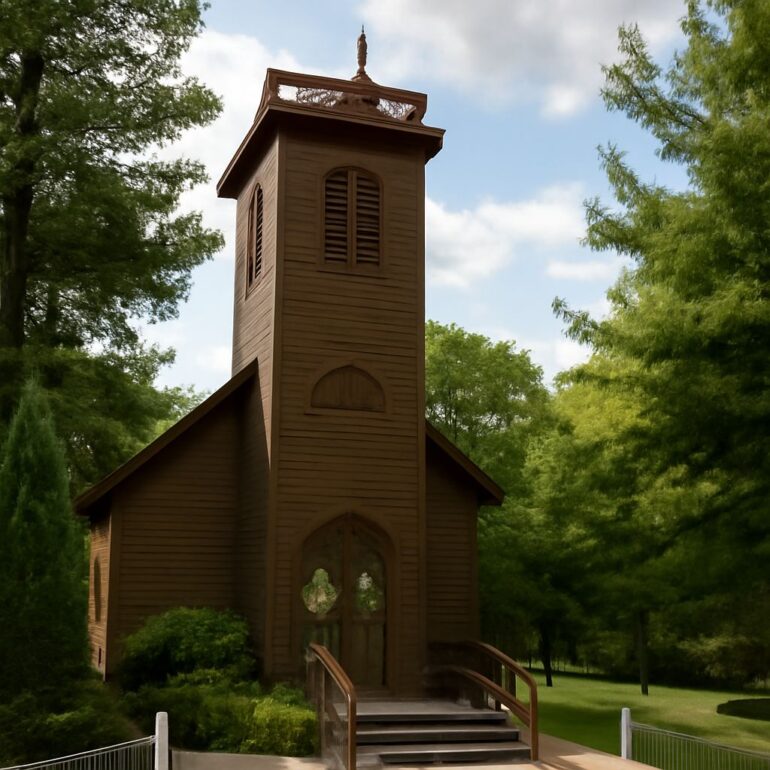
What place inspired the familiar hymn about a church in the woods, and where can its words be found? William S. Pitts wrote its text and tune after encountering an Iowa valley; the small brown church later associated with the song stands near Nashua. Its words describe a remembered place of worship, fellowship, and farewell.
The connection between song and building is compelling, but its familiar telling deserves care. A congregation built a real chapel, while a writer’s recollection helped turn the landscape into a shared image of home. The history of each is related without being quite identical.
Finding the words and identifying the hymn
For the church in the wildwood lyrics, Hymnary’s 1916 hymnal entry provides a published text and identifies Pitts. Its catalog also records other hymnals and settings. Comparing an actual hymnal page with a recording can reveal whether a singer has omitted a verse, repeated the refrain, or followed a different arrangement.
The hymn’s words about a church in a wooded valley move between the landscape, memories of worship, and the people gathered there. A refrain invites the singers back to the place; successive verses give that invitation emotional weight. It is a song of belonging, but it does not avoid parting or death. Those images help explain why it can be meaningful at a memorial as well as a reunion.
Pitts is credited with both words and music. The tune and the lyrics of this wildwood church hymn belong together in the familiar version, though later musicians have arranged them for different voices and instruments. An arrangement can change the pace or harmony without changing the basic identity of the song. A listener looking for a particular performance should check the artist and recording as well as the title.
Little Brown Church: the place behind the association
The chapel commonly called the little brown church in the vale is the former First Congregational Church of Bradford, near Nashua, Iowa. Congregational churches historically organized local church life around the congregation; this building should not be assumed to be a Catholic parish because it is discussed in a publication about church history.
The church’s own history traces the congregation to the settlement of Bradford and says its building was completed in 1864. The congregation chose brown paint before it knew Pitts’s song, according to that account. The building’s color and the hymn’s image later became inseparable in the story told about the site.
A little brown church became both a physical landmark and a name carried far beyond Iowa in song. Its history involves the people who raised funds, built a sanctuary, worshiped there, and sustained its memory as the surrounding community changed. The nearby town of Nashua grew as rail and other development shifted away from Bradford, a distinction that helps explain why both place names appear in accounts of the chapel.
What came first: the song or the building?
A widely repeated account says Pitts saw the valley in 1857 and imagined a church there before the chapel was built. An Iowa history fact sheet presents that sequence and reports that his students sang the piece in the unfinished building in 1864. The scene is memorable: a song about an imagined place is associated with a real congregation that later built in the area.
There is a difference, however, between a cherished local account and a fully settled chronology. A 2023 study in Church History examines how the story was assembled and points out variations in accounts of the first public performance and the building dates. It describes later efforts to connect the song and chapel more closely. Those differences do not erase either the building or Pitts’s authorship; they do limit how confidently a single dramatic version can be presented as established fact.
A useful distinction is between what the hymn says and what later accounts say happened. Its speaker recalls a dear place from childhood. That is a poetic voice, and the line alone is not evidence that Pitts himself grew up beside that exact building. Likewise, a dedication, a performance in an unfinished church, and publication are separate events even when a brief retelling places them close together.
The valley, the congregation, and memory
The words set a modest building within a landscape of trees, flowers, and a valley. These details make the setting easy to picture, but the song’s center is human connection. The church is precious because people worshiped, sang, and formed attachments there. Its small scale allows it to stand for a particular community rather than an abstract institution.
The invitation to return also leaves room for distance. A singer may be away from an actual home church, or may simply recognize the feeling of missing a community that once offered stability. For that reason, a performance can evoke the chapel in Iowa and personal memories at the same time. Neither response requires the listener to know every detail of the local story.
The later verses bring loss into view. A loved person’s absence and the prospect of burial sit alongside the warmth of the refrain. Rather than treating a place of worship as an escape from grief, the song gives grief a place within a community’s shared life. Its plain language allows the shift in feeling to arrive without a formal explanation.
Similar names and later performances
A building called a brown church, or a song about a church in a valley, is not automatically the Iowa landmark or Pitts’s hymn. To identify a source, look for the author’s name, the opening line in a hymnal, and the connection to Bradford or Nashua. The familiar title and the name of the Iowa chapel can appear in different forms, so a title alone is a weak test.
The words of the church hymn set in a wildwood have appeared in many collections, and performers may select different verses. Hymnary’s catalog links individual printings to scans and publication details, making it possible to compare a particular edition instead of assuming that every website reproduces the same text. A recording’s length may also reflect repeated refrains or an instrumental passage rather than an additional verse.
When using a particular arrangement in a service, the relevant edition is the one to check for its text, musical setting, and any permissions. The underlying historical hymn and a modern recording or arrangement are distinct works for that purpose. Naming the version also helps singers follow the same order and lets listeners locate the performance that moved them. A choir director may prefer a printed setting with all parts visible, while a family planning a memorial may recognize a particular recording. In either case, listening and reading together can prevent a mistaken assumption that the chosen version includes every verse. The original setting, the printed edition, and the performer each contribute different information to the choice.
