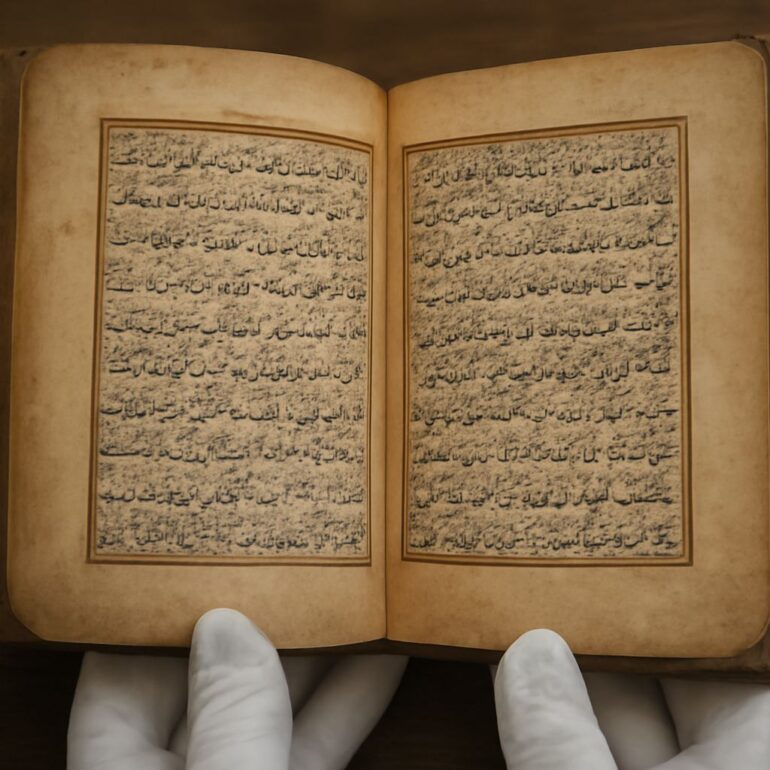
The Quran is the central religious text of Islam, revered by over a billion Muslims around the world. Its origins, authorship, and meaning have shaped both religious and cultural life for centuries. Understanding when was the Quran written, what the Quran is, and who wrote the Quran provides insight into its ongoing significance.
When Was the Quran Written?
The Quran was revealed to the Prophet Muhammad over a period of approximately 23 years, beginning in the year 610 CE and ending in 632 CE, the year of Muhammad’s death. The revelations were delivered orally by Muhammad to his followers throughout his life, often in response to specific events, questions, or needs in the early Muslim community.
During Muhammad’s lifetime, the Quran was not compiled as a single written book. Instead, its verses were memorized by his companions and also written down on various materials, such as parchment, bones, palm leaves, and pieces of leather. This oral and written preservation was essential in a largely oral society.
The formal compilation of the Quran into a single, organized book occurred after Muhammad’s death. The first major effort to collect the Quranic verses began under the first Caliph, Abu Bakr, around 633–634 CE. This initiative was prompted by the deaths of many who had memorized the Quran in battle, which raised concerns about preserving the text accurately.
The process reached its most definitive stage during the reign of the third Caliph, Uthman ibn Affan (ruled 644–656 CE). Around 650 CE, Uthman ordered the preparation of a standardized version of the Quran and sent copies to major centers of the expanding Islamic world. This Uthmanic codex became the foundation for all later copies of the Quran, and its text remains unchanged to this day.
What Is the Quran?
The Quran, sometimes spelled as “Koran,” is considered by Muslims to be the literal word of God (Allah), as conveyed to Muhammad through the angel Gabriel. It is written in classical Arabic and is composed of 114 chapters, called surahs, which vary in length and subject matter.
The Quran covers a wide range of topics, including theology, morality, law, guidance for personal conduct, and stories of earlier prophets. Its verses, known as ayat, address both practical and spiritual aspects of life. Muslims view the Quran as the final and most complete revelation from God, building upon earlier scriptures such as the Torah and the Bible.
Recitation and memorization of the Quran hold a central place in Islamic practice. The text is renowned for its poetic beauty and linguistic precision, which are seen as signs of its divine origin. The Quran is used daily in prayers, legal matters, and as a source of inspiration and guidance.
While the word “Koran” is a common English spelling, “Quran” is now more widely accepted and used by scholars and the Muslim community itself, as it more closely matches the Arabic pronunciation.
Who Wrote the Quran?
Muslims believe that no human being wrote the Quran. Instead, they hold that it is the direct word of God, transmitted to Muhammad, who then conveyed it to his followers. Muhammad is regarded not as the author, but as the recipient and messenger of the divine revelation.
After receiving each revelation, Muhammad would recite the verses to his companions. Many of them memorized the text, earning the title of “hafiz” (one who preserves). Others wrote the verses down immediately or shortly after, ensuring both oral and written preservation.
The question of who wrote the Quran is therefore answered by Islamic tradition as: God revealed the Quran, the angel Gabriel delivered it, Muhammad received and recited it, and his followers preserved it through memorization and writing. The later compilation was an act of organizing, not authoring, since the words themselves were believed to be unalterable and divine.
Non-Muslim historians examine the process of compilation and transmission, acknowledging the historical efforts of Muhammad’s companions and later community leaders in preserving and standardizing the text, but traditional Islamic belief firmly maintains that Muhammad himself was not the author in the conventional sense.
The Quran in Public Life
The Quran has played a major role in shaping the laws, values, and culture of Muslim societies. It serves as the ultimate source of religious authority and guidance, influencing everything from ethics to governance. Islamic law, or Sharia, is largely derived from the Quran and the traditions of Muhammad.
Public recitation of the Quran is a common feature in Muslim-majority countries, whether in daily prayers, religious festivals, or important life events. Quranic verses are often displayed in homes, mosques, and public spaces as reminders of faith and guidance.
In modern times, interpretations, translations, and studies of the Quran continue to be widely published, making it accessible to non-Arabic speakers around the world. The Quran’s message of monotheism, justice, and compassion continues to inspire millions, both in personal spirituality and in broader public life.
Understanding when was the Quran written, what the Quran is, and who wrote the Quran helps explain its enduring influence and the deep respect it commands within and beyond the Muslim community.
