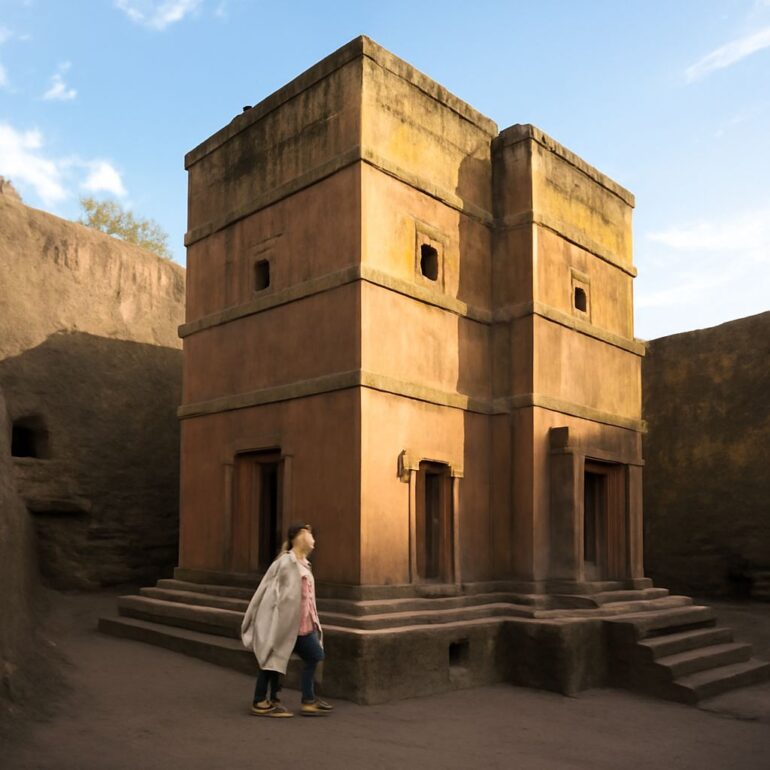
The churches at Lalibela in northern Ethiopia are places of worship cut from living rock. Their courtyards, passages, and interiors form a sacred landscape used by the Ethiopian Orthodox Tewahedo Church. They are also a UNESCO World Heritage site, recognized for architectural achievement and an enduring religious tradition.
A church in Lalibela can appear below ground level because builders removed the surrounding stone to reveal walls, roofs, and interior spaces. The best-known complex is traditionally associated with King Lalibela, although the dating of individual structures remains a subject of archaeological study.
Lalibela Church Architecture: Carving a Sacred Landscape
The UNESCO World Heritage listing identifies eleven medieval churches at the site. Rather than assembling each building from blocks, builders cut into the rock itself. They excavated trenches and courtyards around structures, then shaped doors, windows, columns, roofs, and rooms. In some cases a church remains connected to the surrounding rock; in others it stands within a trench as a largely freestanding mass.
This distinction helps explain the word monolithic, meaning formed from a single mass of material. It describes the relationship between a structure and the rock from which it was carved, rather than suggesting that the building was moved into position. A visitor looking down into a courtyard sees the result of removing stone as well as the building that remains.
The Lalibela churches are connected by a network of passages, steps, and courtyards. Movement between spaces is part of the experience of the site: an entrance may lead through a narrow passage before opening into a larger excavated court. Interiors have their own architectural details, including pillars and arches cut from the rock, as well as religious furnishings used in worship.
Groups and named churches
The main churches are commonly described in northern and southeastern groups, with Bete Giyorgis set apart. These descriptions help visitors understand their relative positions, although local spellings and ways of grouping individual spaces can vary. The churches are not interchangeable rooms in a single building: each has its own dedication, layout, and role in the religious landscape.
In the northern group, Bete Medhane Alem is known for its large rock-cut form and surrounding columns. Bete Maryam, dedicated to Mary, is another important church in the group. Its carved features and decoration are part of a setting in which religious art, architectural form, and worship belong together.
Bete Amanuel, in the southeastern group, has carefully articulated exterior walls whose details recall traditions of built Ethiopian architecture. Bete Abba Libanos is another church in this part of the site, linked to a religious tradition associated with its name. Passages and adjacent excavated spaces make the group more complex than a row of independent buildings.
Bete Giyorgis, or the Church of St. George, is widely recognized for its cross-shaped plan. Cut down into the rock and surrounded by a deep court, it can be seen from above as well as approached through an excavated route. This Lalibela church has a distinctive cross shape that does not describe every structure in the complex.
King Lalibela and the problem of dating
The site is associated with the Zagwe ruler Lalibela, who reigned in the late twelfth and early thirteenth centuries. UNESCO describes the complex as a “New Jerusalem,” connecting its sacred landscape with Jerusalem and pilgrimage. The idea helps explain names and religious associations at the site, but it does not supply an exact construction date for every wall or passage.
A religious account gives another kind of evidence. According to the king’s hagiography, or traditional account of a saint’s life, angels helped Lalibela create the churches. The Metropolitan Museum of Art presents this tradition as part of the king’s story. It communicates the religious significance attached to the site; it is not an engineering record of how many people worked there or how long each excavation took.
The same museum notes that exact dating of the complex and its components remains unresolved and describes a scholarly proposal for several phases between the seventh and thirteenth centuries. That broader reconstruction differs from an account assigning every structure to one reign. Archaeologists examine construction features, relationships between excavated spaces, and other evidence to reconstruct a sequence, while acknowledging the difficulty of dating rock cuttings precisely.
These approaches answer different questions. Royal and devotional traditions show how a community remembers the site’s origins. Archaeological study investigates when and how its features developed. Neither should be silently substituted for the other: the churches can be deeply connected to Lalibela’s memory while scholars continue to test the chronology of particular structures.
A living Ethiopian Orthodox site
The churches of Lalibela belong to a continuing Ethiopian Orthodox Tewahedo religious tradition. They are not Catholic institutions. The Ethiopian Orthodox Church has its own history, liturgy, clergy, and traditions; its relationship to other Christian churches should not be flattened by calling all ancient Christian sites Catholic.
Worship, prayer, and pilgrimage remain central to the site’s meaning. Priests, worshippers, and pilgrims use the churches as sacred places rather than treating them solely as examples of medieval engineering. Religious celebrations can bring large numbers of people to the town, but everyday care and prayer also connect the buildings to the community.
Sacred objects and spaces may have rules governing access or photography. Visitors should follow instructions from the custodians, ask before photographing people, and expect some areas or moments to be reserved for worship. Removing shoes where requested and allowing processions or services to proceed without interruption are practical ways to respect the site’s religious life.
These courtesies arise from the nature of the place. A visitor may be interested in the craft of cutting stone, while a worshipper may have come to pray. Both encounters can take place in the same church, provided that the people responsible for worship and care can carry out their work.
World Heritage and conservation
UNESCO inscribed the property titled Rock-Hewn Churches, Lalibela on the World Heritage List in 1978. The designation recognizes its outstanding universal value; it does not replace the site’s religious identity or make UNESCO its sole owner or manager. Ethiopian institutions and the Orthodox community remain central to its care.
The stone faces challenges from water, weathering, and human use. Because the buildings are cut into their setting, conservation must consider roofs, courtyards, drainage, and the surrounding rock together. A repair that protects one surface may affect another part of the system, so investigation and monitoring matter alongside physical intervention.
Protective shelters have been installed over some churches. They reduce direct exposure to rain and sun, while their appearance and long-term effects raise conservation questions of their own. UNESCO’s 2018 account records discussions with the local Orthodox administration about conservation; it illustrates the need for cooperation between heritage specialists and those responsible for the sacred site.
The Lalibela churches therefore have more than one kind of value. Their carved architecture offers evidence of remarkable technical and artistic traditions, while their continuing use gives them meaning for a living community. Protecting the site means attending to both: the condition of the rock and the worship, knowledge, and care that sustain these Ethiopian sanctuaries.
