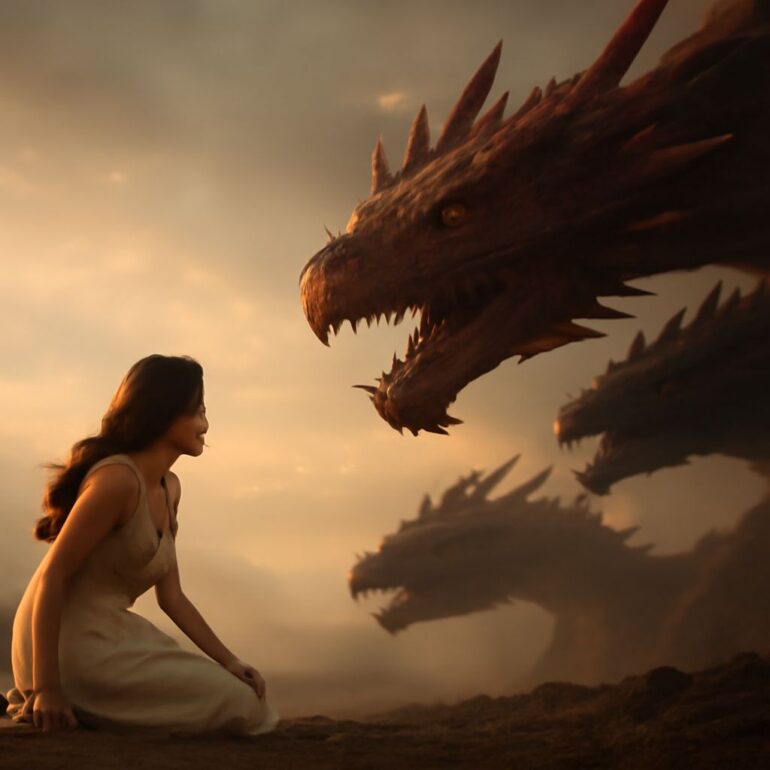
The dragon of Revelation 12 appears in a vision of conflict that moves from the sky to heaven and then to earth. It threatens a woman and her child, fights Michael and his angels, and turns against the woman’s other offspring. The chapter gives the creature a name: the Devil and Satan.
The image belongs to a sequence, not just a single dramatic scene. Reading Revelation’s dragon alongside the woman, the child, and the heavenly voice makes its role clearer. The full chapter and explanatory notes are available in the New American Bible, Revised Edition, published by the U.S. Conference of Catholic Bishops.
Revelation Dragon: The Signs in the Sky
Revelation 12 opens with a woman clothed with the sun, with the moon under her feet and a crown of twelve stars. She is pregnant and cries out in labor. The narrator calls her a great sign, a detail that invites the reader to consider what the figure represents as well as what happens to her in the vision.
Another sign follows: a huge red dragon with seven heads, ten horns, and seven diadems, or royal headbands, on its heads. Its tail sweeps a third of the stars from the sky and throws them to earth. The creature then waits before the woman, intending to devour her child at birth. In Revelation, dragon imagery gives the struggle a visible form before the story names its adversary. The description places apparent power and destructive purpose together.
With the red dragon, Revelation presents a threat to the child before the child can act. She gives birth to a son destined to rule the nations, but the child is caught up to God and his throne. The woman flees to a place prepared by God in the desert, where she is to be cared for 1,260 days. The attack fails, and the account shifts to another scene of conflict.
The USCCB notes read the woman as a symbol of God’s people in both the Old and New Testaments: Israel gives birth to the Messiah, and the church suffers persecution. This is an interpretation supplied by the notes, grounded in the chapter’s imagery and related biblical passages. The text’s description of a mother and son has also been associated with Mary and Jesus in Christian interpretation. The symbolic reading of God’s people helps explain why the woman later has other offspring who bear witness to Jesus.
The Dragon Is Named
War breaks out in heaven. Michael and his angels fight the dragon and its angels; the dragon’s side does not prevail and loses its place in heaven. Verse 9 calls the creature the ancient serpent, the Devil, and Satan, who deceives the whole world. It and its angels are thrown down to earth.
That identification is explicit. The dragon in Revelation is presented as Satan within the vision, while “ancient serpent” connects the figure to a wider biblical vocabulary of deception. The USCCB note on the verse points to the serpent in Genesis. Readers can recognize that connection without treating every detail of the two passages as if it described the same scene.
A loud voice in heaven then announces salvation, power, and the authority of God’s Anointed. It calls the defeated figure an accuser who had accused the faithful before God. The voice says that they overcame him through the blood of the Lamb and the word of their testimony. In Revelation, the Lamb is a central image for Christ. The passage joins victory to faithful witness, including witness that carries the risk of death.
The heavenly voice also warns earth and sea: the Devil has come down in fury, knowing his time is short. The movement matters to the story. A defeat in heaven is followed by danger on earth; the chapter does not end with the dragon’s fall. Its remaining actions show where that anger is directed.
The Woman’s Flight and Her Offspring
After being cast down, the creature pursues the woman who gave birth. She receives the wings of a great eagle and flies to her place in the desert, where she is cared for away from the serpent. The chapter gives another period for her protection: a time, times, and half a time. The USCCB notes discuss these time expressions in relation to the period of distress depicted in the book.
The serpent sends a torrent of water after her, but the earth opens and swallows the flood. Both the wings and the earth’s intervention are part of the vision’s account of protection. The scene gives the woman a place of refuge while the threat continues around her.
Angered by its failure against her, the dragon goes to make war on the rest of her offspring. The chapter identifies them as those who keep God’s commandments and bear witness to Jesus. This detail moves the conflict from the woman and child to a community of witnesses. It also explains why the dragon’s defeat and its continued hostility can stand together in the narrative.
In Revelation 12, dragon imagery carries this sequence from the threat to the newborn through heavenly conflict to persecution on earth. The figures have relationships and roles in the story: the child is taken to God, Michael leads the heavenly resistance, and the woman’s offspring become the target of the dragon’s anger. Reading those movements in order gives more substance than assigning an isolated meaning to each visual feature.
The Dragon and the Beast
The next chapter introduces a beast rising from the sea. The USCCB text of Revelation 13 says the dragon gives the beast its power, throne, and great authority. The two figures are therefore connected, but they are distinct characters in the vision. A second beast comes from the earth and acts in support of the first.
The USCCB notes interpret the sea beast as a symbol of the Roman Empire and connect its worship with emperor worship. That historical reading belongs to the notes’ interpretation of chapter 13; the direct identification of the chapter 12 dragon as Satan comes from the text itself. Keeping the two claims separate helps a reader see the difference between what the vision names and how a commentary understands its historical setting.
Later Christian art may give Revelation’s red creature wings, a particular shape, or a setting chosen by the artist. Revelation describes heads, horns, crowns, color, and actions, but an artwork can add details to make the scene visible. Its choices can illuminate a tradition of interpretation; they should be compared with the passage before being treated as details the chapter supplies.
The same care applies to attempts to match the vision to a present-day leader, nation, or event. Such claims go beyond the chapter’s explicit naming and depend on an interpreter’s argument. The text offers a defined sequence and identifies the dragon as the Devil and Satan; a contemporary political identification requires separate evidence and should be labeled as interpretation.
