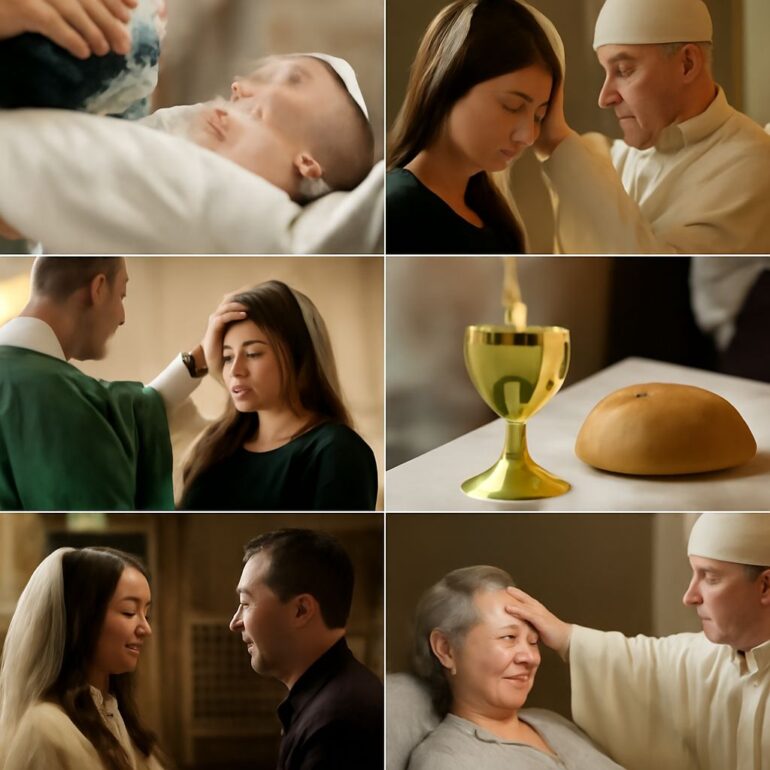
The seven sacraments are the central signs of grace in Catholic life. They begin with Baptism, strengthen believers through Confirmation and the Eucharist, restore them through Penance and Anointing of the Sick, and serve the Church through Holy Orders and Matrimony.
If you are new to the faith, Catholic baptism and Catholic confession are important starting points. Baptism is the sacrament of new life in Christ; Confession is the ordinary way Catholics receive forgiveness for sins committed after Baptism.
The Seven Sacraments at a Glance: Purpose of Each
The seven sacraments are grouped as sacraments of initiation, healing, and service. Each uses a visible sign to communicate God’s grace.
- Baptism: Baptism washes away original sin and any personal sins, gives new birth in Christ, and welcomes a person into the Church.
- Confirmation: Confirmation strengthens baptismal grace and seals the believer with the Holy Spirit for mature Christian witness.
- Eucharist: The Eucharist makes Christ present under the appearances of bread and wine. It nourishes Catholics and deepens communion with God and the Church.
- Penance, or Confession: This sacrament forgives sins committed after Baptism, restores friendship with God, and reconciles the person with the Church.
- Anointing of the Sick: Anointing brings spiritual strength, peace, and courage to those who are seriously ill or weakened by old age. It may also bring physical healing if that serves God’s will.
- Holy Orders: Holy Orders gives bishops, priests, and deacons a sacred ministry of serving, teaching, worshiping, and shepherding the Church.
- Matrimony: Matrimony joins a baptized man and woman in a lifelong covenant. It gives grace to their marriage and family life.
Baptism, Confirmation, and the Eucharist establish Christian initiation. Penance and Anointing of the Sick heal spiritual or physical wounds, while Holy Orders and Matrimony equip people for service and faithful love.
What Happens in Catholic Baptism: Essential Signs and Effects
In Catholic baptism, water is poured over the person’s head or the person is immersed while the minister says, “I baptize you in the name of the Father, and of the Son, and of the Holy Spirit.” Water represents cleansing and new life, and the Trinitarian words are essential to the sacrament.
A priest or deacon normally administers Baptism, although anyone may baptize in an emergency if the person is in danger of death. The person must use water, say the correct formula, and intend to do what the Church does in Baptism.
Baptism removes original sin and personal sins, joins the person to Christ’s death and Resurrection, and makes the person a member of the Church. It also leaves a permanent spiritual character, so a valid Baptism is received only once.
Infants are baptized on the faith of their parents and godparents, who promise to raise them in the faith. Adults first learn the basics of Christianity, repent of sin, profess faith, and usually receive Baptism, Confirmation, and the Eucharist together at the Easter Vigil.
How Catholic Confession Works: From Examination to Absolution
Catholic confession is also called the Sacrament of Penance or Reconciliation. A penitent examines their conscience, feels genuine sorrow, confesses sins to a priest, accepts a penance, and receives absolution.
Confession is especially necessary for serious, or mortal, sins. Catholics should confess each mortal sin by kind and approximate number, while confessing venial sins is also helpful and encouraged. If you do not remember an exact number, give your best estimate.
The priest listens in confidence, may ask a brief question, and offers counsel. He then assigns a penance, such as a prayer or work of charity. After the penitent expresses sorrow, the priest gives absolution in Christ’s name, and the penitent responds, “Amen.”
Absolution requires sincere contrition and a real intention to turn away from sin. It does not require perfect feelings or a promise that you will never struggle again; it requires an honest desire to change and to avoid occasions of sin.
A Catholic Confession Guide: Preparation, Words, and Penance
Use this Catholic confession guide when preparing for your first Confession or returning after a long absence.
- Examine your conscience. Pray quietly and review your actions, words, thoughts, and omissions since your last confession. Consider the Ten Commandments, the Beatitudes, and your duties toward God and other people.
- Be sorry and choose to change. Make an act of contrition before entering the confessional. Contrition means sorrow for sin because it harms your relationship with God, together with a firm purpose of amendment.
- Begin clearly. Greet the priest and say, “Bless me, Father, for I have sinned. My last confession was…” Then name your sins plainly, without lengthy stories or excuses. Include the kind and number of serious sins, as far as you can recall.
- Listen and express sorrow. Answer the priest’s questions honestly and receive his advice. When he asks you to make an Act of Contrition, you may say: “My God, I am sorry for my sins. I intend to amend my life and avoid sin. Amen.”
- Receive absolution and complete your penance. Listen as the priest pronounces the words of absolution and respond, “Amen.” Before leaving, remember the penance he assigns and complete it as soon as reasonably possible.
