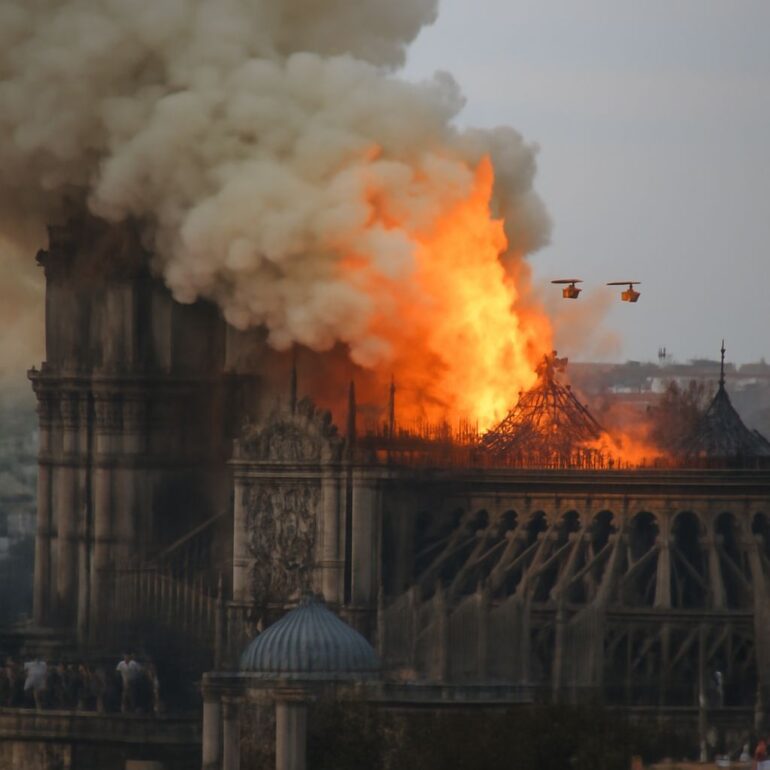
On April 15, 2019, fire swept through the roof of Notre-Dame de Paris, destroyed its spire and much of its historic timber framework, and damaged the stone vaults below. Firefighters saved the main structure and towers. Following a major restoration, the cathedral reopened for worship in December 2024.
The cause of the blaze remains unconfirmed in the sources reviewed. Investigators considered several possibilities, while restoration authorities secured the building and coordinated its reconstruction. The distinction matters: an explanation for the damage is not the same as proof of what ignited the fire. Sources for this account were checked on November 4, 2026.
An evening of alarms and escalating fire
Notre-Dame was already undergoing restoration when the fire began. On the evening of April 15, an initial alarm prompted a check, but no fire was found. A second alarm followed, and the blaze was located in the roof space. By then it had spread through a structure that was difficult to reach and contained a large quantity of old timber. The National Fire Protection Association’s account describes a significant delay in notifying firefighters after the first alarm, when the initial search failed to locate the fire.
Images of Notre Dame Cathedral burning showed flames rising above the roof and spire. Firefighters fought the blaze through the evening, including an operation to prevent it from reaching the bell towers. The spire collapsed, and sections of the roof and vaulting fell. By the morning of April 16, the fire was extinguished. The surviving walls and towers gave the reconstruction a foundation, but they required close examination and support before extensive work could begin.
The cathedral’s long history helps explain the extent of the loss. Its roof structure included medieval oak framing, sometimes called the “forest” because of the many trees used to build it. Above the crossing, where the long body of the church meets the transept, stood a nineteenth-century spire designed by architect Eugène Viollet-le-Duc. Both represented different periods in the life of the same building.
Notre Dame Cathedral Fire Cause: What the Investigation Established
The Notre Dame Cathedral fire cause has not been definitively established in the reporting reviewed. In June 2019, Paris prosecutors said their preliminary inquiry had found no evidence supporting a criminal origin. They also opened a judicial investigation into possible involuntary damage. Reuters’ report on that announcement distinguishes the absence of evidence for a criminal act from the continuing inquiry into how the blaze began.
Prosecutors mentioned an electrical malfunction and a poorly extinguished cigarette among possible explanations. Those were hypotheses, not findings identifying the ignition source. In December 2024, The Associated Press reported that authorities still had not identified the origin. The reported search for the cause of the cathedral fire therefore has a narrower result than a categorical claim that one particular accident started it.
The fire at Notre Dame’s cathedral also raises a separate question about response: how alarms were interpreted and when firefighters were called. The sequence can be examined independently of the ignition source. A delay in finding flames may help explain how a fire grew, but it does not identify the first spark. Likewise, restoration work was under way at the building; its presence alone does not establish that the work caused the blaze.
What the fire damaged—and what survived
The most visible losses were the spire and the timber frameworks supporting the lead-covered roofs over the nave, choir, and transept. The nave is the main central space; the choir is the area around the sanctuary; the transept forms the crosspiece of the cathedral’s plan. According to the public restoration establishment, the medieval nave and choir frameworks and the nineteenth-century spire and transept framework were destroyed.
Falling material broke through parts of the stone vaults, the curved masonry ceilings beneath the roof. Other vaults remained standing, helping shield the interior. The Cathedral of Notre Dame fire left a building that was neither wholly destroyed nor ready for immediate reconstruction. Its standing masonry, artworks, and fittings needed individual assessment, cleaning, protection, or repair.
Firefighters and cathedral personnel also worked to remove important objects, including the Crown of Thorns relic. The great organ survived, but soot and dust made a painstaking dismantling and cleaning necessary. The distinction between a surviving object and an undamaged one is practical: each required a different conservation response and a different schedule.
From emergency stabilization to reopening
The first task after the cathedral burned was to make the site safe. Heat, water, unstable masonry, and the remains of scaffolding around the former spire complicated access. Crews installed supports, protected vulnerable structures, and removed damaged material. The restoration establishment states that this securing phase made the cathedral ready for restoration by summer 2021.
France created a dedicated public establishment to oversee the project, bringing together architects, engineers, craftspeople, conservators, and contractors. Its task was to organize the work across many trades while respecting the building’s heritage. The reconstruction of the roof frames and spire began in the fall of 2022, using oak and traditional carpentry alongside modern planning and engineering. The rebuilt spire followed Viollet-le-Duc’s design; reconstructing it restored a familiar part of the skyline while acknowledging that its predecessor belonged to the nineteenth century.
Inside, specialists cleaned stone surfaces, restored paintings and decorative work, repaired vaults, and reassembled the organ. Each operation depended on others: fragile materials had to be secured before adjacent work could proceed, and rebuilding the roof protected work below. This was an institutional undertaking as well as a craft achievement, requiring decisions about sequence, resources, and responsibility over several years.
Donations financed the work. In November 2024, restoration chief Philippe Jost told AP that approximately €140 million remained from the funds and would support further preservation in agreement with donors. That distinction matters for accountability: the reopening marked the completion of a major phase, while the care of an old building continued.
On December 7, 2024, Archbishop Laurent Ulrich reopened Notre-Dame in a ceremony that included the sounding of the restored organ. The first Mass followed on December 8, as AP reported. Exterior work remained after worship resumed, including work on parts of the cathedral that had needed attention before the 2019 blaze.
The project also had to preserve a record of what had survived. Documentation helped specialists distinguish original fabric from replacement material and coordinate decisions across workshops. That record gives future conservators a clearer basis for assessing the building and its repairs.
Reading claims about the fire
To assess a claim about why the Notre Dame cathedral burned, identify who made it, when, and whether it describes an observed event, a working hypothesis, or a final finding. The collapse of the spire and the reopening are documented events; an electrical fault or cigarette remains a reported possibility in the sources above. Check a newer official statement or reliable report for a change in the investigation before presenting either possibility as the established cause.
