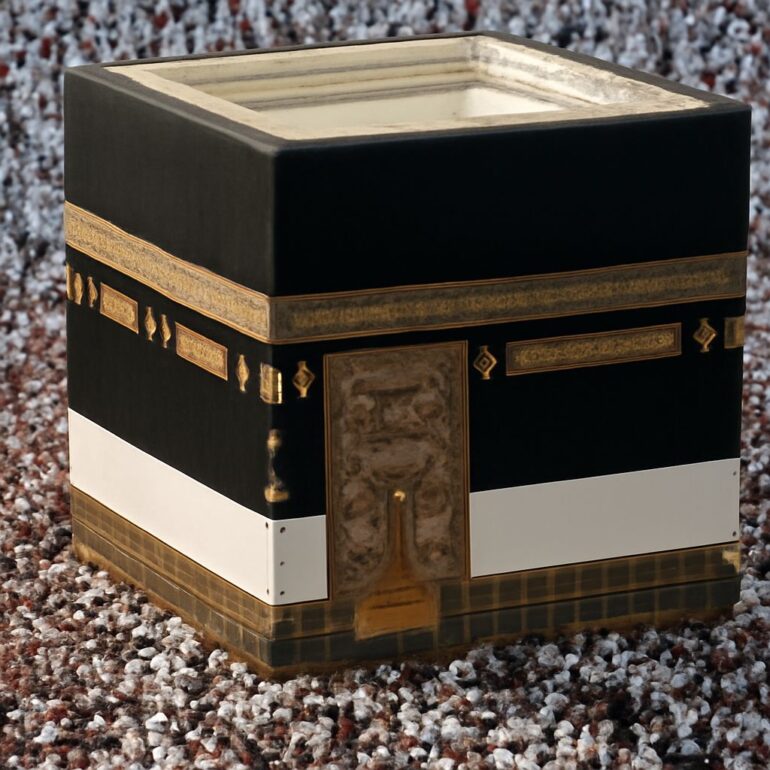
The Kaaba, or Ka’aba, stands as the heart of the Islamic world, a sacred structure located in the Masjid al-Haram mosque in Mecca, Saudi Arabia. Millions of Muslims around the globe face the Kaaba during their daily prayers and undertake the pilgrimage, or Hajj, to this revered site. Its history and construction date back centuries, and what’s inside the Kaaba fascinates many. Let’s explore the rich history, the timeline of its construction, and the secrets held within its walls.
History of the Kaaba
The history of the Kaaba is deeply intertwined with Islamic tradition. According to Islamic belief, the Kaaba was originally constructed by the Prophet Ibrahim (Abraham) and his son Ismail (Ishmael) as a house of monotheistic worship. The structure has undergone numerous renovations and reconstructions over time, reflecting the changing eras and needs of the Muslim community.
Before the advent of Islam, the Kaaba served as a site for various tribal deities of Arabian tribes. However, it was the Prophet Muhammad who re-dedicated the Kaaba to the worship of the one God, Allah, following the conquest of Mecca in 630 CE. This pivotal moment marked the Kaaba’s transformation into the central religious symbol it is today.
Construction Timeline
When was the Kaaba built? The exact date of the Kaaba’s initial construction remains uncertain, primarily because it predates recorded history. However, Islamic tradition suggests that it was first built by Prophet Ibrahim and Ismail. Over the centuries, the Kaaba has been rebuilt several times due to natural disasters and human actions.
One significant reconstruction occurred in 608 CE, just a few years before the Prophet Muhammad began receiving revelations. During this renovation, the Quraysh tribe, who were the custodians of the Kaaba, decided to rebuild it using funds obtained from lawful sources. This reconstruction involved adding a roof to the previously open structure and raising its walls.
Another notable rebuilding took place in the 17th century after the structure was damaged by floods. Throughout its history, each reconstruction has aimed to preserve the sanctity and historical essence of the Kaaba, ensuring it remains a central pillar of Islamic faith.
Inside the Kaaba
Many people are curious about what’s inside the Kaaba. Contrary to what some might imagine, the interior of the Kaaba is relatively simple and unadorned. The walls inside are clad with a fabric known as the Kiswah, which is replaced annually. The space is small, with a floor made of marble and limestone.
Inside, there are three pillars that support the roof and a small table. Several hanging lamps and a staircase leading to the roof are also present. Unlike many religious sites, the Kaaba’s interior does not house any images or statues, reflecting the Islamic principle of aniconism – the avoidance of images in worship settings.
The inside of the Kaaba is opened only twice a year for cleaning ceremonies, attended by a select few dignitaries and religious leaders. This rare occasion adds to the mystery and reverence surrounding the Kaaba.
The Kaaba continues to be a focal point of Islamic worship, its history rich with tradition and its simplicity echoing the core tenets of Islam. Understanding the Kaaba’s history, construction, and contents provides a deeper appreciation for its role in the Islamic faith and its enduring significance.
