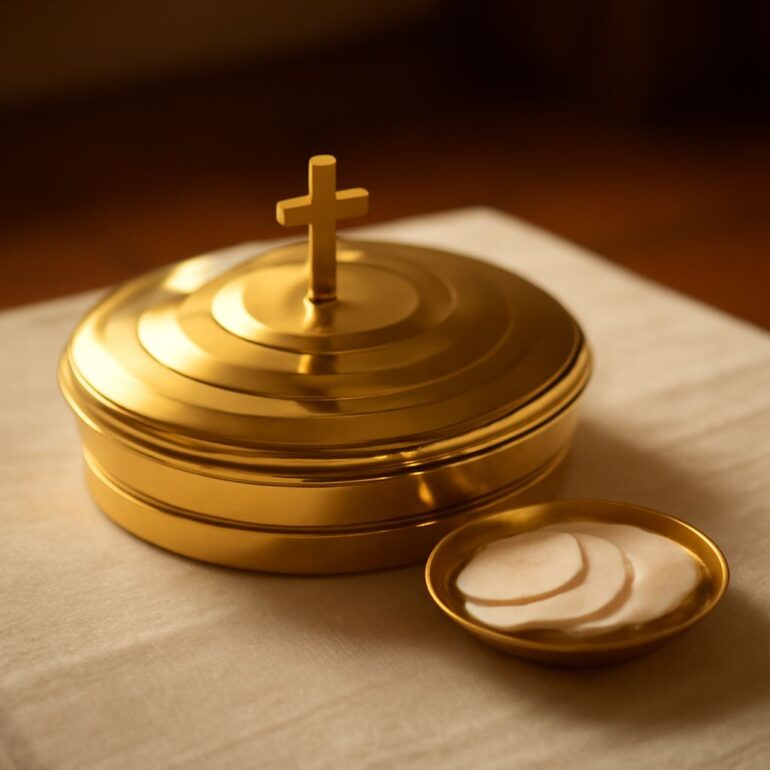
Bread and wafers for Communion come in forms designed for different traditions, congregation sizes, and methods of distribution. A congregation choosing them also needs to consider the vessels, preparation time, and handling required by its service.
The choice of bread for Communion begins with the church’s own liturgical practice. Catholic requirements for the Eucharist are specific; other Christian communities may use different ingredients or ways of serving. A convenient package is useful only when its contents and use fit the service for which it is intended.
Communion Bread: Ingredients and Form
For a Latin Catholic Mass, the General Instruction of the Roman Missal states that the bread must be made only from wheat, recently made, and unleavened. The same instruction calls for natural, unadulterated wine from the fruit of the vine. Water is also used in the celebration. These requirements concern the elements used in the sacrament, sometimes called its matter; a supplier’s religious labeling alone does not establish what a product contains.
A larger host can be broken for distribution, making the shared bread visible in the rite. Small hosts remain permitted when the number of communicants or pastoral reasons call for them. Communion wafers offer a uniform portion and are easy to count, while a larger host requires a plan for breaking and distributing its pieces. Each communion wafer should be handled and stored with care. Both forms need protection from moisture and enough turnover to remain fresh.
Elsewhere, a congregation may use communion bread in a loaf, individual pieces, or another form consistent with its tradition. A communion cracker is a different product category, and recipes can include ingredients beyond wheat. Its appearance should not be used to decide whether it meets Catholic requirements. Ask the supplier for an ingredient list and preparation details, then compare them with the rules of the particular church.
Dietary Needs and Preparation
For someone with celiac disease, ingredient choices have practical consequences. The USCCB’s guidance explains that completely gluten-free hosts are not valid matter for Catholic Mass. Low-gluten hosts may be valid when they meet the Church’s conditions, but they still contain gluten. The guidance describes permission for their use and recommends making arrangements through the parish.
A person unable to receive even a low-gluten host may receive under the form of wine alone. Parish ministers can arrange a separate chalice and take steps to prevent cross-contact. The appropriate choice depends on the individual’s medical needs and a conversation with the parish, including how the host or vessel will be prepared and handled.
Other communities may have different rules for gluten-free alternatives. In either setting, a clear ingredient list and separate handling matter when an allergy or intolerance is involved. A label such as “low gluten” does not tell an individual whether a product is safe for that person’s condition.
Cups, Chalices, and Distribution
A chalice is the vessel used for wine in Catholic worship; a ciborium is a covered vessel commonly used for hosts. When comparing drinking vessels, a church should consider the method of distribution, the number of ministers, the stability of the vessel, and the care needed after the service. Capacity matters: a vessel should hold the amount actually needed without being difficult to carry or prone to spilling.
For Catholic Mass, sacred vessels must meet the requirements for their materials and construction set out in the Roman Missal’s instruction. The rules also address purification after use. The U.S. bishops’ norms describe how Communion is distributed and how the remaining consecrated elements are treated. A disposable individual cup therefore cannot be selected for Mass solely because it is inexpensive or easy to distribute.
In other churches, individual reusable or disposable cups may fit the congregation’s practice. Reusable vessels require a washing and storage routine; disposable ones require a disposal plan. A tray sized for the cups can help ministers carry and distribute them steadily. The amount poured into each cup and the number of people serving determine how much preparation the format requires.
Ready-to-Use Portions
Prefilled communion cups combine a measured drink with a separate bread or wafer compartment in a sealed unit. They can reduce preparation and allow a church to estimate quantities by counting packages. They also create packaging waste, and some people may find a small seal difficult to open. A sample should be opened before a bulk order to assess the seal, the taste and texture, and whether the portion can be handled comfortably.
A communion packet may be useful when a community distributes individual portions at a large gathering or carries them to a separate location. Check the label for the drink, bread ingredients, expiration date, and storage conditions. Heat, damaged seals, and long storage can affect the contents. Keep enough spare portions for unexpected attendance, but buy quantities that can be used while fresh.
Prepackaged communion is not a single recipe or a universal liturgical format. A package containing ordinary grape juice, for example, should not be assumed suitable for Catholic Mass: the Catholic rules distinguish wine and, in particular circumstances, mustum prepared under specific conditions. By contrast, the United Methodist Church describes unfermented grape juice as its longstanding practice. Local leaders can identify what their own tradition permits and how the elements are to be distributed.
What a Set Should Include
Communion sets for church use vary from portable cases to equipment for an altar or a large congregation. A portable set might contain a small chalice, a container for bread, a cloth, and a carrying case; a larger arrangement might include trays and individual cups. Some sets contain vessels only, so bread and wine or juice must be purchased separately. Examine the itemized contents rather than relying on a photograph.
For Catholic visits to people who cannot attend Mass, a pyx is a small vessel used to carry the consecrated host. The parish’s ministers can determine the appropriate vessel and procedure. For a gathering using individual portions, count the trays and cups as well as the consumables: a set with too few places still leaves work to be done during the service.
When comparing these sets, look at replacement parts, cleaning instructions, case dimensions, and whether the vessels fit securely inside. A durable portable case matters if it will be carried regularly; for a fixed location, storage space and ease of cleaning may matter more. A set is economical only if its contents match the service and can be maintained over time.
Match the Purchase to the Service
Start with the church’s rules, then estimate attendance and decide how the elements will be prepared and distributed. For Catholic church communion supplies, verify the bread and wine against the liturgical requirements and choose suitable sacred vessels. A large parish may need small hosts and additional vessels; a homebound ministry may need a secure carrying vessel and a clear parish procedure.
A congregation that permits individual portions may prefer a sealed format for a large event, while a church that breaks a shared loaf will need a different arrangement. Compare the full cost of consumables, vessels, preparation, and disposal across several services. Selecting the equipment in this order connects the purchase to the community’s worship, its members’ needs, and the people responsible for preparing it.
