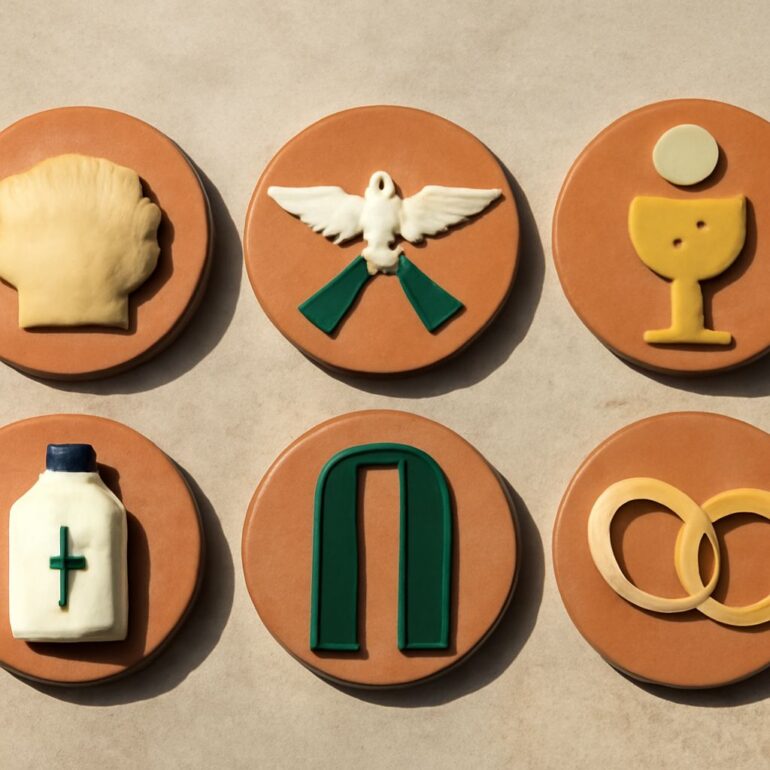
The seven sacraments are the Church’s principal signs of God’s grace. They accompany Christians from Baptism through the challenges of life, healing, worship, and service.
The Church groups the seven Catholic sacraments into three sets: initiation, healing, and service. The sacraments of initiation are Baptism, the Eucharist, and Confirmation; the sacraments of healing are Reconciliation and Anointing of the Sick; and the sacraments of service are Holy Orders and Matrimony.
What Are the Seven Sacraments? A Complete List
Each sacrament uses visible signs and words to express and communicate God’s grace. Together, they address a person’s spiritual beginning, nourishment, healing, and vocation.
- Baptism: Baptism welcomes a person into the Christian community, forgives sin, and gives new life in Christ through water and the Holy Spirit.
- The Eucharist: The Eucharist is the sacramental celebration of Christ’s presence under the signs of bread and wine. It nourishes believers and unites them with Christ and one another.
- Confirmation: Confirmation strengthens the grace of Baptism through a special outpouring of the Holy Spirit and equips Christians to live and share their faith.
- Reconciliation: Also called Confession or Penance, Reconciliation brings God’s forgiveness for sins and restores a person’s relationship with God and the Church.
- Anointing of the Sick: This sacrament gives spiritual strength, peace, and courage to people who are seriously ill or weakened by old age. It may also bring healing according to God’s will.
- Holy Orders: Holy Orders enables bishops, priests, and deacons to serve the Church through preaching, worship, pastoral care, and leadership.
- Matrimony: Matrimony joins a baptized man and woman in a lifelong covenant of faithful love, open to family life and service.
The Seven Catholic Sacraments: Initiation
Baptism, the Eucharist, and Confirmation form one connected path into the life of the Church. Baptism begins that life, the Eucharist continually nourishes it, and Confirmation strengthens it for faithful witness and service.
Confirmation does not replace Baptism or create a separate kind of Christian membership. A baptized person is already joined to Christ and the Church; Confirmation deepens and strengthens that relationship.
The order of these sacraments can vary. In many Latin Catholic communities, children receive Baptism, the Eucharist, and then Confirmation. In Eastern Catholic churches, Confirmation—often called Chrismation—is commonly celebrated with Baptism and the Eucharist.
Sacraments of Healing and Service
Reconciliation and Anointing of the Sick are called sacraments of healing because they address spiritual and physical weakness. Reconciliation focuses on forgiveness and restored communion, while Anointing of the Sick offers grace and strength during serious illness or frailty.
Holy Orders and Matrimony are sacraments of service. They give grace for particular vocations that build up the Church and serve other people. Through Holy Orders, ordained ministers serve the community; through Matrimony, spouses serve one another, their family, and the wider community.
What the Sacrament of Confirmation Means: Sign, Purpose, and Limits
The sacrament of Confirmation confirms and strengthens the grace first given in Baptism. Its central visible sign is anointing the forehead with sacred chrism, usually while the bishop or priest lays on hands and says, “Be sealed with the Gift of the Holy Spirit.”
The anointing points to the Holy Spirit’s lasting presence. Confirmation deepens a person’s relationship with God, unites the person more firmly to the Church, and gives strength to live as a Christian witness. It is associated with the gifts of the Holy Spirit, including wisdom, understanding, courage, and right judgment.
Confirmation is not becoming an adult member of the Church. Baptism has already made the person a member of Christ’s body, and Confirmation is not a spiritual graduation or a reward for completing religious classes.
Preparation helps candidates understand and freely embrace the sacrament, but the sacrament depends on God’s grace rather than on passing a course. Confirmation is a beginning of deeper Christian responsibility: those who receive it are called to keep growing in faith, worship with the Church, serve others, and witness to the Gospel.
