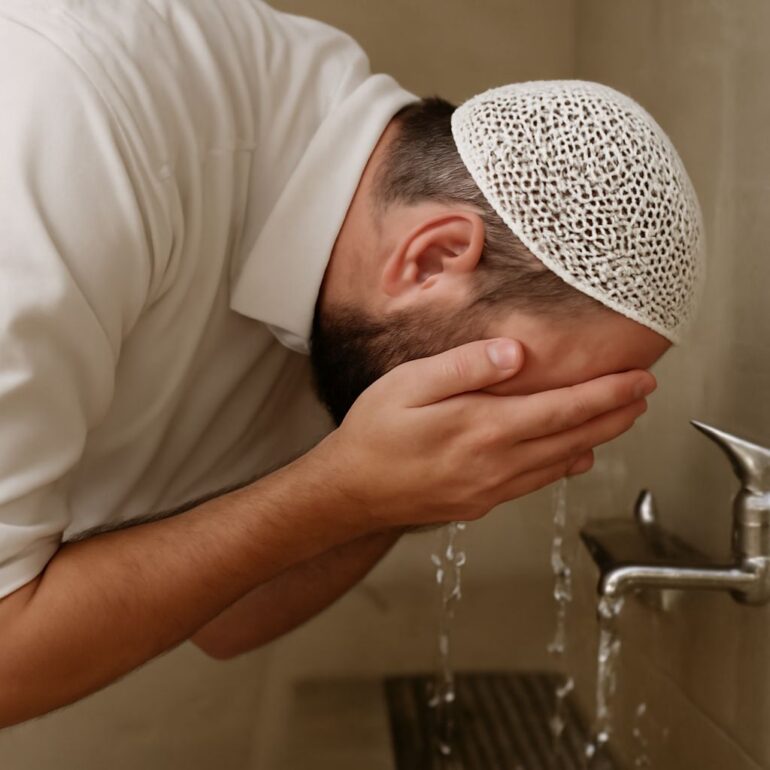
Wudu is a key act of purification in Islam, required before performing daily prayers and certain other acts of worship. Learning the correct wudu steps is essential for every practicing Muslim. This guide explains how to perform wudu with simple instructions and answers to common questions, so you can make sure your ablution is complete and valid every time.
What Is Wudu?
Wudu (ablution) is the ritual washing that Muslims perform to prepare for prayer (salat) and other acts of worship. It is both a physical and spiritual cleansing. Without valid wudu, prayers are not accepted, making it a fundamental part of Islamic practice.
The practice of wudu is described in the Quran and was demonstrated by the Prophet Muhammad (peace be upon him). It involves washing specific parts of the body in a particular order with clean water. The intention (niyyah) to purify oneself for worship is a key part of this act.
Wudu is required before the five daily prayers, touching the Quran, and other acts of devotion. It is also recommended at other times, such as before sleeping or entering the mosque. Understanding how to wudu properly helps Muslims maintain ritual purity throughout the day.
Essential Wudu Steps
To perform wudu correctly, follow these essential steps in order. Each step should be done with clean water and the intention to purify yourself for worship. Here is a step-by-step guide on how to perform wudu:
-
Make your intention (niyyah):
Before starting, silently form the intention in your heart that you are performing wudu to prepare for prayer. Saying it aloud is not necessary, but being mindful is important.
-
Say ‘Bismillah’ (In the name of Allah):
Begin your wudu by saying “Bismillah.” This is a Sunnah (recommended), but it is good practice to start every act of worship with the remembrance of Allah.
-
Wash your hands up to the wrists three times:
Use your right hand to pour water over your left and vice versa, making sure to clean thoroughly between the fingers and around the wrists. Repeat this three times for each hand.
-
Rinse your mouth three times:
Take a handful of water, rinse your mouth, and spit it out. Do this three times to ensure the mouth is clean.
-
Rinse your nose three times:
Inhale water gently into your nostrils using your right hand, then expel it using your left. Repeat this three times. This step cleans the nose passages.
-
Wash your face three times:
Wash your entire face from the top of your forehead to the bottom of your chin, and from ear to ear. Do this three times, making sure no part of the face is left dry.
-
Wash your arms up to and including the elbows three times:
Start with your right arm, then the left. Cover the entire arm, including the elbows, and wash three times each. Make sure water reaches all areas, especially in between fingers and around the elbows.
-
Wipe your head once (masah):
Wet your hands and wipe them over your head starting from the forehead to the back and returning to the front. This is done only once.
-
Wipe your ears once:
With wet fingers, wipe the inside and back of both ears in one motion. Do not use new water; use the water left on your hands from wiping the head.
-
Wash your feet up to and including the ankles three times:
Start with your right foot, then the left. Make sure to wash between the toes and cover the entire foot up to the ankles. Repeat three times for each foot.
Follow this order without skipping any step. If you forget a step or the sequence, restart from the missed point. After finishing, recite the shahada (“Ash-hadu alla ilaha illallah wa ash-hadu anna Muhammadan abduhu wa rasuluhu”) as a Sunnah.
Common Questions About Wudu
What breaks wudu? Wudu is invalidated by anything that exits from the private parts (urine, feces, gas), deep sleep, loss of consciousness, vomiting, or touching the private parts directly with the hand. If wudu is broken, it must be performed again before prayer.
Is wudu necessary before every prayer? Wudu is required before each prayer unless you have not broken it since the last one. If you are unsure, repeat the wudu to be safe.
Can you perform wudu with socks or shoes on? If you already had wudu before putting on socks or shoes, you may wipe over them (masah) instead of washing your feet, but only for a certain period (24 hours for residents, 72 hours for travelers). The socks must be clean, cover the ankles, and not let water through easily.
What if water is unavailable or harmful? If clean water is not available or cannot be used for health reasons, you may perform tayammum (dry ablution) with clean earth or stone by wiping the face and hands. This replaces wudu until water is available.
Can I talk during wudu? It is best to focus on the act, but talking does not invalidate wudu. The main thing is to complete the steps in the right order with the proper intention.
Knowing wudu steps and how to perform them correctly ensures that your prayers are valid and your acts of worship are accepted. Regular practice and understanding make the process easier and more meaningful over time.
