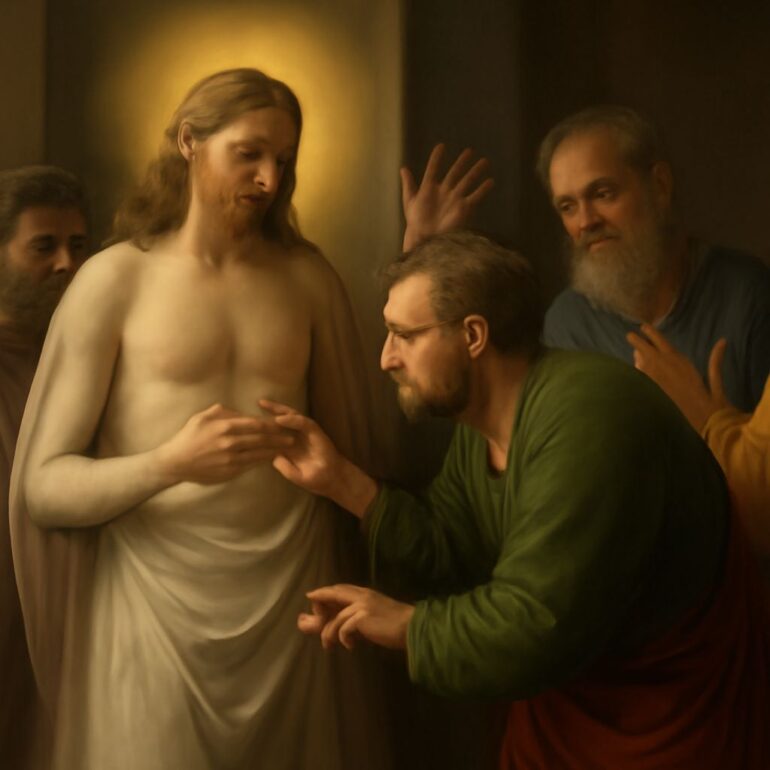
Thomas, one of Jesus’ twelve apostles, is remembered for asking to see the risen Jesus before believing the other disciples’ report. In John’s Gospel he then recognizes Jesus with a confession of faith. His appearances also include a declaration of loyalty and a question about the way to the Father.
The Bible’s account of Thomas is concentrated in a few passages, while later traditions tell of his ministry beyond them. Reading those sources in their own settings gives a fuller picture than his familiar nickname alone.
Thomas in the Bible: One of the Twelve
Who was Thomas in the Bible? The Gospels name Thomas among the Twelve, the group Jesus chose as apostles. An apostle is a person sent on a mission; in the New Testament the Twelve have a particular role as Jesus’ chosen companions and witnesses. Thomas the Apostle appears in the lists, but the Gospel of John gives him several individual speaking parts.
John calls him Didymus, a Greek name meaning “twin.” The USCCB note to John 11 explains that Thomas is derived from the Aramaic word for twin. The text does not identify his twin in its account of these events. Knowing the name helps readers recognize him when an edition says “Thomas, called Didymus.”
In the Bible, Thomas speaks when Jesus decides to return to Judea after the death of Lazarus. The disciples have just recalled the danger Jesus faced there. Thomas tells his fellow disciples that they too should go and die with him. The words appear in John 11:16, before the raising of Lazarus. They give the reader a scene of resolve in the face of danger, alongside the better-known later account of uncertainty.
In John 14, Jesus speaks to the disciples about going to prepare a place for them. Thomas says they do not know where Jesus is going and asks how they can know the way. Jesus answers that he is the way, the truth, and the life. The question provides an opening for that teaching. The exchange gives Thomas a role in the conversation rather than presenting him only through a later label.
The Encounter After the Resurrection
The most familiar episode comes in John 20:19–29. On the evening of the first day of the week, the risen Jesus comes to the disciples, shows them his hands and side, and gives them peace. Thomas is absent. When the others tell him they have seen the Lord, he says he will not believe unless he sees the marks of the nails and puts his hand into Jesus’ side.
A week later, the disciples are again together, this time with Thomas present. Jesus comes among them, offers peace, and invites Thomas to look at his hands and put a hand into his side. Jesus calls him to believe. Thomas answers, “My Lord and my God!” The account records the invitation and the response; it does not state that Thomas actually touched the wounds.
The meeting between Jesus and Thomas is not an isolated contest over evidence. The disciples had already received an appearance of the risen Jesus, and Thomas asks for a form of encounter comparable to what they reported. John’s account places his confession after Jesus’ invitation and before a blessing for those who have not seen and yet have believed. The passage then explains that the Gospel’s signs are written so readers may believe that Jesus is the Messiah, the Son of God.
In the story of doubting Thomas, Scripture moves from the disciples’ testimony to a personal encounter and then to a statement addressed beyond the room. The nickname captures the first part of his response, but the narrative ends with his confession. Both are needed to follow John’s sequence.
When discussing doubting Thomas, the Bible verse John 20:27 gives Jesus’ invitation; the surrounding verses provide the absence, the request, and the confession. Reading the whole passage also shows what the text leaves unstated. It is possible to describe the invitation to touch without turning it into a claim that the touch occurred.
More Than a Nickname
The name “Doubting Thomas” has become a common description of someone who wants proof. It is a compact way to recall the episode, but John presents more than a personality sketch. Thomas asks a question in chapter 14, urges his companions to go with Jesus in chapter 11, and speaks in chapter 20 after hearing the others’ testimony. Each scene has its own setting.
The conversation of Thomas and Jesus also gives readers two related perspectives on belief. Thomas has the testimony of companions before he sees Jesus; the closing blessing speaks to those who will believe without seeing. In the Gospel’s own frame, later readers encounter the story through written testimony. The issue is therefore larger than a single person’s hesitation.
After the resurrection account, John 21:2 includes Thomas among the disciples gathered by the Sea of Tiberias. He is part of the group to whom Jesus appears beside the water. The passage does not give him a separate speech there, but it places him with the others in the Gospel’s final chapter. Acts 1:13 also names him among the apostles gathered in Jerusalem after the ascension.
Later Ministry and Remembrance
The New Testament passages do not provide a detailed account of Thomas’s later journeys or death. Christian communities in India preserve a tradition connecting him with the beginnings of their churches. In a letter concerning the Saint Thomas Christians, Pope Francis refers to the apostle Thomas who, according to tradition, brought the Gospel to India, and to the anniversary of his martyrdom.
That tradition has lasting importance for the identity and worship of communities bearing his name. It should be identified as a later account when placed beside John’s narrative: John describes encounters with Jesus and appearances among the disciples, while the Indian tradition tells of a subsequent mission. The distinction helps a reader locate each claim in its source without diminishing the place the tradition holds for those communities.
St. Thomas, apostle and remembered witness, is thus associated with both scriptural scenes and later Christian memory. A church named for him may draw on that wider history as well as the Gospel passage. Its name alone does not establish which episode or source a particular image or account represents.
Names and Books
The apostle should be distinguished from Thomas Aquinas, the medieval theologian and Dominican friar, who lived many centuries later. Both are called Saint Thomas in Catholic usage, so the setting and dates matter. A reference to the Twelve points toward the first-century disciple; a discussion of medieval theology may concern Aquinas.
The Gospel of Thomas is another distinct question. It is a collection of sayings attributed to Thomas, rather than one of the four Gospels in the New Testament. Attribution in a title is not, on its own, proof that the apostle wrote the work. The biblical Gospel of John and a later text bearing his name should be identified separately before their contents or historical claims are compared.
