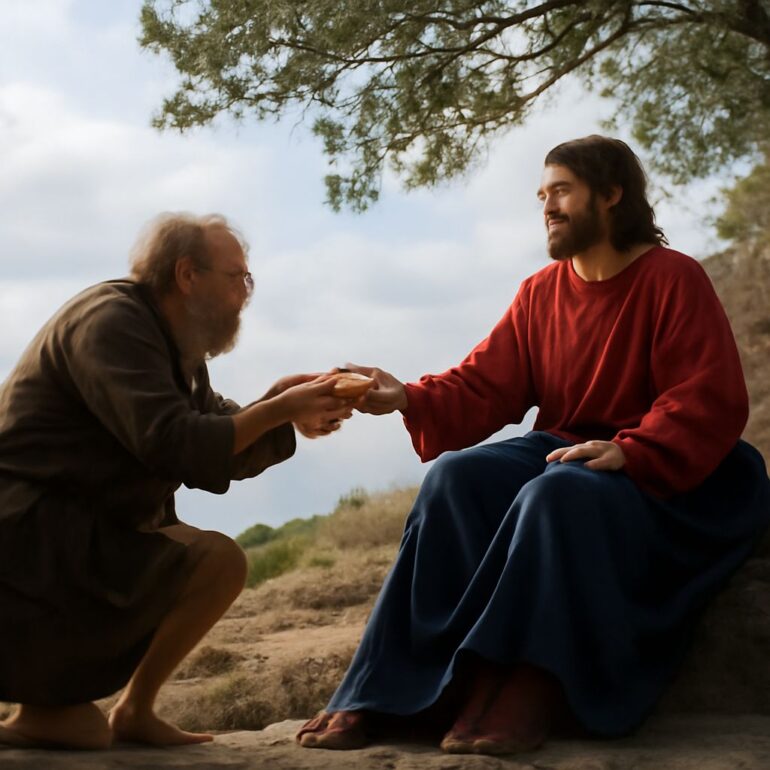
After his baptism, Jesus goes into the wilderness, where he is tested by the devil. Matthew and Luke describe three challenges and Jesus’ replies from Scripture; Mark gives a much shorter account. Their differences in order and detail are part of the way each Gospel tells the story.
The accounts of Jesus’ testing in the desert connect the episode to his identity, his relationship with the Father, and the beginning of his public ministry. The passages can be read side by side in the New American Bible, Revised Edition (NABRE), published by the U.S. Conference of Catholic Bishops.
Temptation of Jesus in the Gospel Accounts
Matthew 4:1–11 says the Spirit leads Jesus into the desert to be tempted. Jesus fasts for forty days and forty nights and is hungry. Matthew presents Jesus as tempted after this fast, before his ministry begins. The devil challenges him to turn stones into bread, then takes him to the temple and urges him to throw himself down. Finally, the devil offers him the kingdoms of the world if he will worship him. Jesus refuses each challenge with words from Deuteronomy. The devil leaves, and angels minister to Jesus.
Luke 4:1–13 likewise places the episode after Jesus’ baptism. Jesus, full of the Holy Spirit, is led in the desert for forty days and eats nothing during that period. Luke presents the bread challenge first, the offer of kingdoms second, and the temple challenge last. At the end, the devil departs “for a time,” a phrase that leaves the reader attentive to later conflict in the Gospel.
Mark 1:12–13 is more compressed. The Spirit drives Jesus into the desert, where he remains forty days, tempted by Satan. Mark mentions wild beasts and angels who minister to him, but does not recount three individual exchanges. Its account leads quickly into Jesus’ proclamation of the kingdom after John is arrested.
The temptation of Jesus in the desert thus appears in all three accounts, although only Matthew and Luke set out the three challenges in dialogue. Each follows the baptismal scene, where Jesus’ identity is announced, and precedes the account of his ministry. That position gives the testing a place in the larger narrative rather than leaving it as a free-standing moral example.
Bread, Trust, and Worship
In Matthew and Luke, the first challenge concerns hunger. The devil asks Jesus, if he is the Son of God, to command a stone or stones to become bread. Jesus answers with words from Deuteronomy: human life depends on more than bread alone. Matthew includes the continuation about every word that comes from God’s mouth; Luke gives a shorter form in the NABRE.
The temple challenge again begins with the condition “if you are the Son of God.” The devil cites Psalm 91, invoking angels who will protect him, and urges Jesus to throw himself down. Jesus answers with another passage from Deuteronomy: the Lord is not to be put to the test. In this exchange both speakers use Scripture, but Jesus resists the demand to turn divine protection into a spectacle on command.
The offer of the kingdoms asks for worship. In Matthew, Jesus dismisses Satan and replies that the Lord alone is to be worshiped and served. Luke also reports the offer of authority and Jesus’ refusal in words from Deuteronomy. The temptations of Jesus place physical need, trust in God, and the attraction of power in distinct scenes, each answered within the narrative.
Matthew places the temple second and the mountain with the kingdoms last. Luke reverses those two scenes and ends at the temple in Jerusalem. The Gospels do not explain the reason for the difference in order. Luke’s final location is significant within a Gospel that gives Jerusalem a prominent place, but that literary observation should be kept distinct from a claim about a single recoverable chronology.
Deuteronomy and Israel’s Wilderness
The replies in Matthew and Luke draw on Deuteronomy 8:3, 6:13, and 6:16. In their earlier setting, these passages address Israel’s relationship with God and recall the wilderness journey after the exodus from Egypt. The reference to bread in Deuteronomy 8 recalls manna, the food given to Israel in the desert. The instruction not to test God recalls testing at Massah; the command to worship God alone appears amid warnings against other gods.
The USCCB notes on Matthew 4 interpret the testing in relation to Israel’s experience in the wilderness. They describe Jesus as the obedient Son and compare his responses with Israel’s testing. This is a theological reading of the narrative’s scriptural echoes. It explains why the quotations matter together: they connect the immediate challenges to an earlier story of dependence, worship, and faithfulness.
The forty days also invite comparison with Israel’s forty years in the wilderness. Matthew’s note points as well to the forty-day fasts of Moses and Elijah. Such connections are interpretive links between texts; the Gospel scene itself does not require the reader to treat the number as a timetable for a later event.
What Mark Emphasizes
Mark’s account offers fewer words but a distinctive setting. The Spirit drives Jesus into the desert, and Satan tests him there. Mark places Jesus in the wilderness for forty days, with no account of separate exchanges. The wild beasts are present, and angels minister to him. Mark does not say which animals are meant or describe separate conversations with the tempter. The reader can observe those details without filling in the missing scenes from another Gospel.
The image of Jesus being tempted among wild beasts has prompted interpretation, but the brief passage does not explain the animals’ precise role. The contrast between Satan’s testing and the angels’ service is clear in the text itself. Its economy leaves attention on the movement from baptism to testing and then to proclamation.
The Jesus temptation in the wilderness is also described as the testing in the desert. In this context, “wilderness” and “desert” both point to the setting of the Gospel accounts. The NABRE uses “desert” in these passages; another translation’s choice of “wilderness” need not imply a different location or episode.
Catholic Interpretation and Later Use
The Compendium of the Catechism of the Catholic Church reads the temptation of Jesus Christ in relation to both Adam and Israel. It presents Christ as the new Adam who resists temptation, and links his obedience to his passion. This is a developed theological interpretation, expressed in the Church’s teaching; the Gospel narratives themselves tell the events with their own differing details.
Catholic worship gives the episode a particular place at the beginning of Lent. The Church’s Homiletic Directory connects Jesus’ forty days in the desert with the season’s forty days and presents the Gospel in relation to baptism and Easter. A homily or devotion may draw lessons for a congregation from that connection. Such an application is a later use of the text, distinct from a detail explicitly narrated by Matthew, Mark, or Luke.
For Jesus, temptations in these accounts are met within a story shaped by Scripture and obedience. Reading the three passages in full preserves both their shared setting and their differences: Matthew and Luke provide dialogue and differing sequences, while Mark’s spare account names the desert, Satan, wild beasts, and angels.
