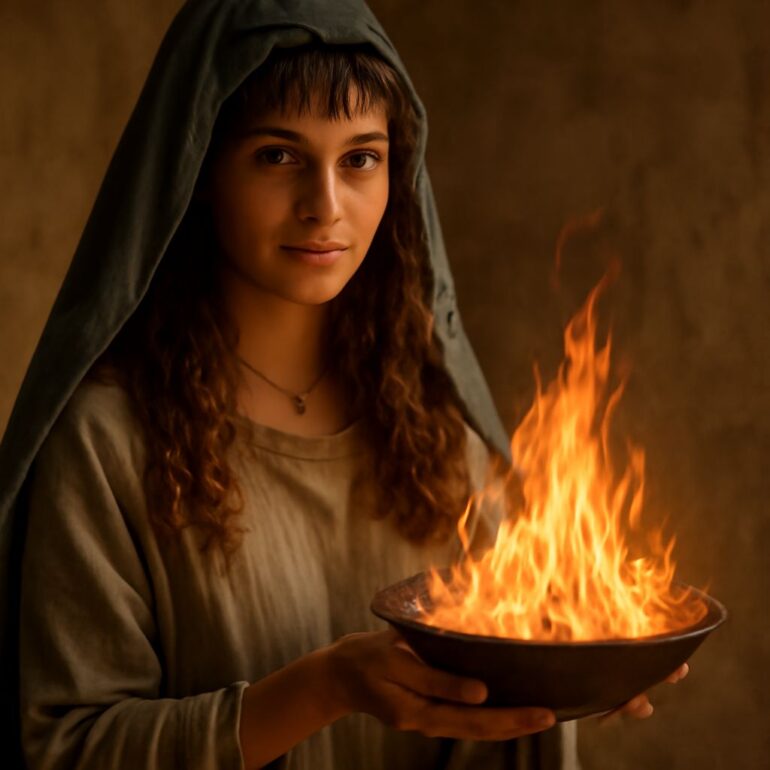
Hestia, the Greek goddess of the hearth, holds a unique place in mythology. Unlike other deities associated with grand narratives of heroism or tragedy, Hestia embodies the everyday sanctity of home and family life. As the goddess of the hearth, she symbolizes warmth, safety, and domesticity, making her an essential figure in Greek culture and religion. This article explores her role and significance in mythology, as well as her relevance in modern times.
Who is Hestia?
Hestia is one of the original twelve Olympian deities in Greek mythology. She is the eldest daughter of Cronus and Rhea, making her a sister to well-known gods like Zeus, Hera, and Poseidon. Despite her significant lineage, Hestia is often depicted as a modest and gentle figure, primarily focused on maintaining the hearth, a central element in Greek households.
Unlike other Olympians, Hestia’s mythology is not filled with dramatic tales of conquest or adventure. Instead, she represents stability, peace, and family unity. Her presence is felt in every home, as she is the embodiment of the hearth’s sacred fire.
Hestia’s Role in Greek Mythology
In Greek religious practice, Hestia’s role was integral to both domestic and public life. She was the first to receive offerings at every household and temple altar, ensuring her blessing on the home and its inhabitants. Her perpetual virginity and commitment to the hearth highlight her role as a protector of family sanctity and communal harmony.
Despite her importance, Hestia does not have as many myths dedicated to her compared to other gods. However, she was highly revered in everyday life. Her lack of dramatic stories underscores her role as the steady, calming influence amongst the sometimes tumultuous passions of the other Greek gods.
Significance of the Hearth and Home
The hearth in ancient Greece was not just a physical structure but a symbol of domestic well-being and unity. As the goddess of the hearth, Hestia was seen as the guardian of this sacred space, which was central to both family and community life. In every household, the hearth served as the focal point for cooking, warmth, and light, making it synonymous with the idea of home.
Hestia’s association with the hearth also extended to the city-state level, where public hearths symbolized community and civic unity. In this way, she played a dual role, protecting both private homes and the communal aspect of Greek life.
Hestia in Modern Contexts
Today, Hestia’s influence can be seen in the way societies value home and family. Her attributes of peace, stability, and hospitality continue to be cherished ideals in modern domestic life. While the physical hearth may no longer hold the central place it once did, the concepts it represented, such as warmth and refuge, remain integral to the idea of home.
In modern spirituality and cultural references, Hestia is often invoked as a symbol of domestic order and harmony. Her legacy endures in contemporary discussions about work-life balance and the importance of creating nurturing, welcoming environments.
Through her enduring qualities, Hestia remains a timeless icon of the hearth and home. Her influence persists not only in mythology but also in our everyday lives, illustrating the lasting power of her presence in the world of Greek gods and beyond.
