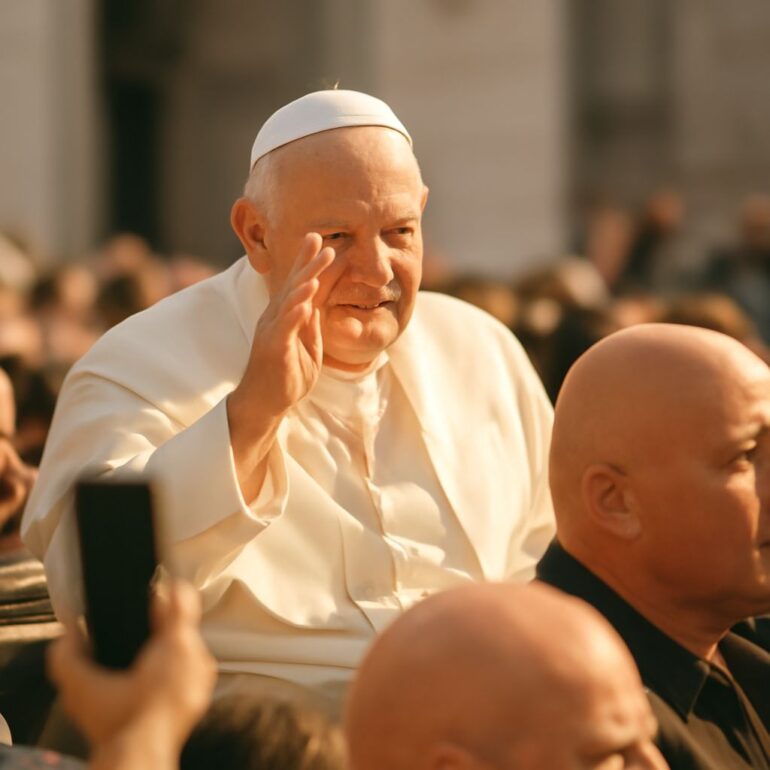
The pope is the bishop of Rome and the Catholic Church’s pastor for the universal Church. His work includes teaching, governing, prayer and pastoral care, carried out in relationship with bishops around the world. In Catholic understanding, the purpose of the papal office is to serve the Church’s unity in faith and communion.
The office is broader than its most visible ceremonies. Understanding what the pontiff does also means distinguishing an authoritative doctrinal definition from an ordinary address, and the Holy See from Vatican City State. These distinctions help explain both the reach and the character of papal authority.
What Is the Purpose of the Pope in Catholic Teaching?
According to Catholic teaching, the pope is the successor of Saint Peter, whom the Church regards as having received a particular responsibility among the apostles. The Catechism describes the bishop of Rome as a visible source and foundation of unity among bishops and the faithful. This is a theological account of the office, not a claim that all Christians agree on papal authority.
What is the purpose of the pope in practice? The Church’s answer connects unity with service: the pope is to strengthen the faithful, protect and explain the faith, and care for the whole Church. The purpose of papal leadership is not limited to making decisions from Rome. The office exists, in this account, to preserve communion among local churches while giving Catholics a common point of reference in matters of faith. It also involves listening to bishops and communities whose circumstances differ across countries and cultures.
The Latin Church’s Code of Canon Law, canon 331, gives the pope supreme, full, immediate and universal ordinary power in the Church. “Ordinary” here means attached to the office itself. “Immediate” means that his authority is not dependent on an intervening bishop for its exercise. These are substantial powers, exercised within the Church’s understanding of its faith and law; they do not make every papal statement a new doctrine.
Pastoral Care and the Bishop of Rome
A bishop is a pastor entrusted with teaching, worship and care for a church community. The pope holds the particular office of bishop of Rome while also bearing responsibility for the universal Church. The two dimensions belong together: his universal ministry is associated with the Roman see, the bishop’s office and church centered in Rome.
What does the pope do as a pastor? He celebrates liturgies, preaches, offers prayers and addresses Catholics on matters affecting their lives. He may visit communities, meet people in hardship or call attention to peace and human dignity. Such actions illustrate how the pontiff carries out his ministry: some involve formal decisions, while others express pastoral concern or invite reflection.
A public audience or a homily can reach far beyond Rome. Its form still matters. A sermon encourages and teaches in a particular setting; a formal legal act does different institutional work. Neither should be understood solely from a headline detached from its audience and context. The work of the pope as a public teacher includes choosing how to address a community, whether through a homily, a formal letter or a meeting with its representatives.
Teaching and the Meaning of Infallibility
Catholic teaching describes the Church’s teaching office as the magisterium. The pope and bishops teach about faith and morals, drawing on Scripture and tradition. Papal teaching can take several forms, including encyclicals, which are letters addressing matters of importance to the Church and sometimes to a wider audience.
In Catholic doctrine, papal infallibility has specific conditions. As the Catechism’s compendium, question 185, explains, it is exercised when the pope, acting as supreme pastor and teacher, proclaims by a definitive act a doctrine concerning faith or morals. This is often called speaking ex cathedra, or “from the chair.” The teaching concerns a doctrine to be held by the whole Church; it is not a claim that the pope cannot sin or make mistakes in other matters.
Ordinary papal teaching can still carry authority without being an infallible definition. An interview, a diplomatic judgment or an informal remark should not automatically be treated as such a definition. The Catechism also describes ways the bishops, in union with the pope, exercise the Church’s teaching authority. The distinction helps readers ask what a document actually claims and how it is presented.
Governance With Bishops and the Roman Curia
What is the role of the pope in governing a worldwide church? Canon law provides for decisions such as appointing bishops, issuing church laws and calling a synod of bishops. A synod is an assembly that assists the pope through consultation on questions affecting the Church. The Code of Canon Law describes both papal authority and the synod’s relationship to it.
The pope normally works through the Roman Curia, the offices that assist him in handling matters of the universal Church. A dicastery is one such department. Curial offices may prepare material, administer areas of responsibility and communicate decisions; their work is carried out in service of the pope’s ministry. This administrative dimension of papal duties is less visible than a public Mass, but it affects how decisions reach local churches.
Local bishops are not merely branch managers. Catholic teaching holds that a diocesan bishop has ordinary and immediate authority to govern the church entrusted to him, exercised in communion with the pope and the wider Church. The Catechism’s compendium describes that authority as the bishop’s own sacred power. A local bishop oversees pastoral life in a diocese; the pope’s universal authority and the bishop’s local responsibility coexist.
Papal responsibilities in relation to bishops include both consultation and, where necessary, intervention. This relationship is institutional as well as personal: bishops retain their pastoral duties even when an issue is discussed at the level of the universal Church. The bishop’s responsibility for a diocese is real, while canon law gives the pope authority concerning the whole Church. The practical question in any particular decision is which office has acted, under which law and with what scope.
The Holy See and Vatican City State
The pope, the Holy See and Vatican City are connected but distinct. The pope is the person holding the office of bishop of Rome. The Holy See, or Apostolic See, refers to that office and, in relevant legal contexts, the central institutions that assist it. The Roman Curia is part of this institutional framework.
Vatican City State is a sovereign territory created by the Lateran Treaty in 1929. Its official explanation distinguishes the state from the Holy See and describes the state as an instrument supporting the latter’s independence. The pope is also sovereign of Vatican City State. The Holy See conducts diplomatic relations, and the state has its own governmental structures; the two are not interchangeable names for a piece of land.
When reading a papal encyclical, identify its intended audience, the subject it addresses and the authority it claims. A letter addressed to bishops and the faithful about a moral question should be read according to its text and stated teaching, rather than assuming from its title alone that every sentence is an infallible definition.
