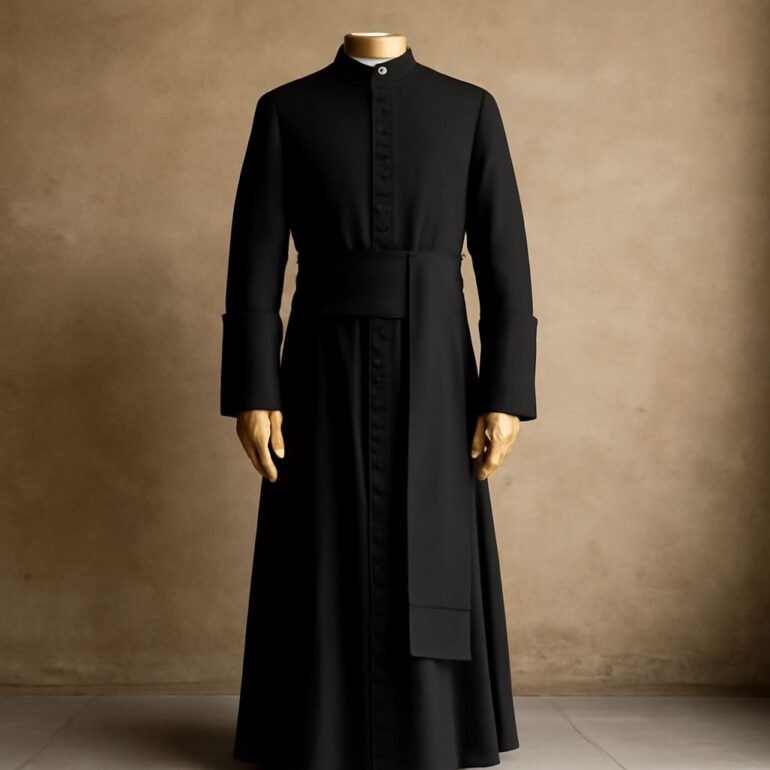
A cassock is a long, close-fitting garment worn by clergy and, in some settings, other church ministers. In the Latin Catholic tradition, a priest’s cassock is commonly black, reaches toward the ankles, and fastens down the front. Its shape makes it recognizable in a procession, a church interior, or an older photograph.
Catholic clerical cassocks appear in several forms. Color, trim, and the clothes worn over them can help identify the setting and the wearer’s role. Those details are best read together: a single garment is one piece of evidence in a larger scene.
Catholic Cassock: Form and Everyday Use
A Roman Catholic cassock generally has long sleeves, a high collar, and a row of front fastenings. Some are cut closely through the body and flare below the waist; others have a looser shape. A sash, sometimes called a fascia, may be tied around the waist. The precise cut and fastening can vary with place, period, and maker.
The cassock of a Catholic priest has a collar and long line that distinguish it from a clerical shirt and trousers. Both can be forms of clerical dress. The cassock offers a continuous silhouette, while the shirt usually makes the white collar visible against a shorter black garment. A photograph may show either according to the occasion and the customs of the community.
In the United States, the bishops’ complementary norm for canon 284 says that the use of the cassock is at the cleric’s discretion. It also calls for the vesture prescribed by the relevant liturgical books during rites. This is a rule for Latin Church dioceses in the United States, so it should be read in that jurisdiction.
The cassock of a priest may therefore appear at a church office, a formal gathering, or a service, while clerical street clothing appears in many other settings. Climate, local custom, the institution, and the event all affect the choice.
Read Color and Trim in Context
Black is the familiar color for a Catholic priest cassock in the Latin tradition. Bishops and cardinals have additional forms of dress associated with their offices. A bishop’s choir dress includes a violet cassock; a cardinal’s includes scarlet. Choir dress is formal clerical clothing worn for certain public church functions, including participation in worship when the wearer is not vested as the celebrant.
The 1969 Holy See instruction Ut sive sollicite, reproduced with its Latin text and an English translation, describes these forms and the colored details on black cassocks for bishops and cardinals. The same source describes dress for certain other prelates, whose distinctions differ by office.
In an image, a bishop’s black cassock may show red trim and buttons, while a cardinal’s black dress may carry scarlet details. A violet or scarlet garment can make rank more visible in formal settings. The pope is commonly seen in white. Color is a useful clue, but local practice, the occasion, and the rest of the person’s dress are needed for a reliable identification.
The distinction between a black garment with colored edging and a garment made entirely in that color matters. A narrow line along the front can be easy to miss in a group photograph, yet it tells a different story from the broad field of color in formal choir dress.
Who Else May Wear a Cassock?
A cassock worn by a priest belongs to a wider family of church dress. Seminarians and altar servers may wear cassocks in some institutions and liturgies. Choir members may also wear similar long garments. Other Christian traditions have their own forms of the garment.
The context often provides the first clue. A group wearing matching black cassocks beneath white garments may be a choir or a group of servers. Their location and actions can help explain their role. A caption, program, or reliable description can identify the people when the clothing alone leaves a question.
Religious communities may wear a habit, a garment associated with their order, rather than the same clerical dress used by diocesan clergy. Eastern Catholic churches also have distinct traditions of clerical clothing. The Latin forms described here should be understood within their own setting.
The Cassock and Liturgical Vestments
A cassock is clerical dress; liturgical vestments are garments prescribed for particular rites. The difference becomes visible when a white or colored layer is placed over the long garment.
A surplice is a white garment with sleeves, commonly worn over a cassock for certain services or by ministers serving at the altar. An alb is a long white garment used by ministers in the liturgy. A stole is a narrow band worn by ordained ministers in the manner appropriate to their office. A chasuble is the outer vestment ordinarily worn by the priest celebrant at Mass.
The General Instruction of the Roman Missal specifies that the chasuble is normally worn over the alb and stole. It also distinguishes the alb from a surplice over a cassock in settings where the chasuble or certain other vestments are required. The layers thus tell the reader something about the rite as well as the wearer.
The priest’s long cassock may be partly or entirely hidden beneath those layers. Liturgical colors on the stole and chasuble relate to the celebration or season; they serve a different purpose from the rank-related colors of clerical dress.
A Brief Historical Perspective
The long clerical garment developed from forms of clothing used in earlier European dress and became associated with clergy over time. The cassock in Catholic clerical dress reflects later rules and local tailoring. A historic image may therefore differ in cut, accessories, or detail from a contemporary scene.
A cassock in the Latin Catholic tradition in an old photograph is easiest to interpret when the date and place are known. The setting may be a seminary, a parish, a procession, or a school; each offers different clues about who is pictured. Historical captions and institutional records can place the garment in that setting.
Is everyone in a cassock a priest? Priests are among its wearers, and seminarians, servers, and members of choirs may wear similar garments. The occasion, other vesture, and a dependable caption help establish the person’s role.
