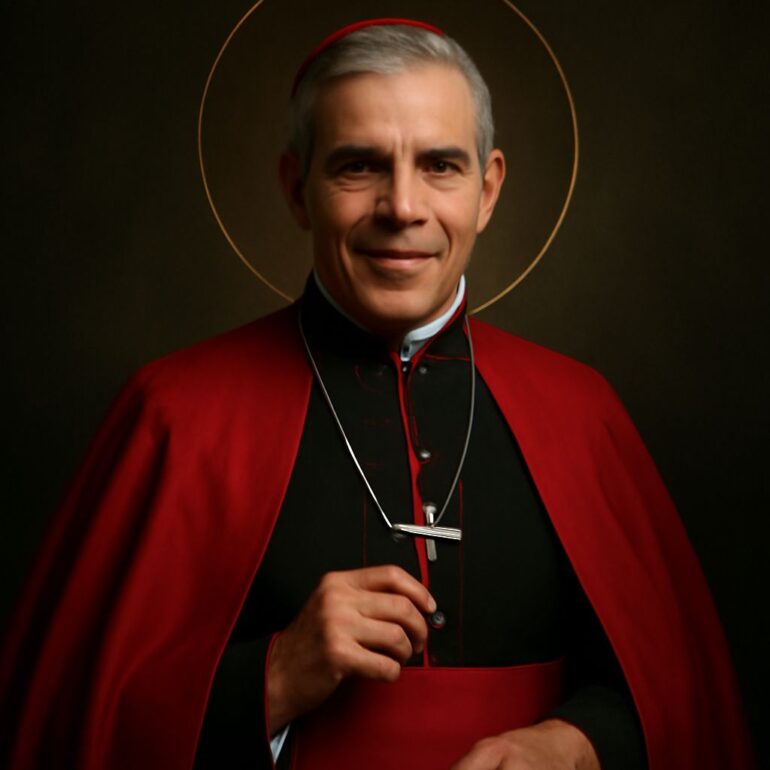
How did a Catholic bishop become one of the recognizable faces of early American television? Fulton J. Sheen brought experience as a priest, university teacher, and radio preacher to a medium reaching millions of households. His televised talks combined religious teaching with commentary on personal life and public affairs.
Sheen later served as bishop of Rochester and received the title of archbishop after leaving that office. His career can be understood through those distinct Church appointments as well as the broadcasts that made him famous. The Catholic Church beatified him in 2026, a later institutional judgment separate from the historical record of his work.
Bishop Sheen and the Road to Broadcasting
Born in El Paso, Illinois, on May 8, 1895, Fulton John Sheen grew up in the Peoria area. He was ordained a priest for the Diocese of Peoria in 1919 and pursued advanced studies in Europe. He went on to teach philosophy at The Catholic University of America in Washington, D.C., where he worked for many years.
The university’s biographical account connects his academic career with a growing public role as a speaker and author. His training mattered to his broadcasting: he sought to explain theological and philosophical ideas to listeners who did not necessarily share a classroom or a religious background with him.
Radio offered a way to reach that broader audience. Sheen became a regular speaker on The Catholic Hour, a national program associated with the National Council of Catholic Men. Its format placed Catholic perspectives within a medium that brought scheduled talks and entertainment into homes across the United States.
The radio audience included Catholics and others, and its size did not make a broadcaster an official spokesperson on every question. The priest’s public teaching reflected his own subjects and style as well as the Church institutions that sponsored particular programs.
From priest to bishop
In 1951, Sheen was appointed an auxiliary bishop of New York and consecrated on June 11. An auxiliary bishop assists the diocesan bishop; he is a bishop, but he is not necessarily the bishop who governs the entire diocese. Sheen also worked for the Society for the Propagation of the Faith, a Catholic organization supporting missionary activity.
Bishop Fulton Sheen entered television with both an episcopal office and substantial experience addressing a national audience. In 1952, Life Is Worth Living began its run. The Catholic University of America’s media history traces that development and describes how the program combined theology, philosophy, and discussion of contemporary issues.
His clerical title appeared prominently in publicity, but a program’s audience was not limited to members of the Church. The distinction between Church office and public celebrity is important: the authority attached to his office, the editorial choices made for a broadcast, and viewers’ reactions were different parts of the same career.
Life Is Worth Living
The television program featured Sheen speaking directly to viewers, often using a blackboard, stories, gestures, and a carefully staged presentation. Instead of presenting a complete church service each week, he used a lecture format to connect moral and religious ideas with questions about family, work, suffering, and public life.
Bishop Sheen adapted his presentation to the demands of the medium. The technique depended on translation between settings. Ideas developed in sermons, books, or a university classroom had to fit a limited broadcast time and a general audience. Viewers could encounter an identifiable Catholic teacher without attending a Catholic parish, while the show’s appeal also depended on the conventions of early television.
The Television Academy’s record lists his Emmy recognition for outstanding personality at the 1953 awards. The award documents a particular industry judgment; it does not by itself establish the size of every episode’s audience or the long-term effect of his teaching on viewers.
Bishop Fulton J Sheen later presented The Fulton Sheen Program, another series that continued his use of television talks. The Sheen Foundation biography dates that program to 1961–1968. Recordings can be studied for their rhetoric and production as well as for the religious arguments he made.
Rochester and the title of archbishop
In 1966, Sheen became Bishop of Rochester, New York. Unlike his earlier auxiliary role, this appointment placed him in charge of a diocese. He held the office until resigning in 1969. Those years involved local pastoral and administrative decisions alongside his national public profile.
After his resignation, he received the title of titular archbishop of Newport. A titular see is a historic episcopal title assigned without making its holder the governing bishop of a present-day diocese at that location. The Archdiocese of San Francisco’s biography distinguishes his Rochester service from that later title.
Thus “bishop” and “archbishop” both appear in accounts of the same man, but they refer to different points in his career and different kinds of appointment. Calling him Archbishop Fulton Sheen in a discussion of his later life is accurate; it would be misleading to describe him as Archbishop of Rochester during his tenure there.
The former Rochester bishop continued writing and preaching after leaving the diocese and died in New York on December 9, 1979. His books and recordings remained available to later audiences, who could encounter his work outside the historical setting of its first broadcast.
Public teaching and institutional context
Sheen spoke about prayer, the life of Christ, moral choice, and suffering, and he also addressed political questions of his time, including communism. A particular talk should be read or watched in full and dated before its statements are applied to later debates. His rhetorical style and the Cold War setting shaped the way many topics were presented.
His prominence illustrates how Catholic institutions engaged mass media in the twentieth century. Radio networks, television schedules, sponsors, production teams, and national organizations all helped determine how an individual speaker reached an audience. The work was public religious communication within a wider media system, not simply a private sermon reproduced unchanged.
A historian can study the techniques that made his presentations memorable while also asking how well particular claims were supported and how listeners responded. Popularity, a Church appointment, and a later honor are separate kinds of evidence. Each tells the reader something different about the preacher and his influence.
Later recognition and questions
The Catholic Church declared Sheen venerable in 2012. A beatification scheduled for 2019 was postponed after concerns were raised about whether his handling of clergy assignments in Rochester required further review. Catholic University’s account of the cause describes the postponement; it should not be compressed into an unqualified conclusion about an individual case.
The process subsequently resumed. On September 24, 2026, Sheen was beatified at a Mass in St. Louis and may be called Blessed Fulton Sheen. The Diocese of Peoria’s statement records the event, and Associated Press reporting provides an independent account. Beatification and canonization are distinct stages; the former does not mean he has been canonized.
His career remains significant because it shows a Catholic teacher using radio and early television to reach a national audience while also serving in formal Church offices. For further reading, the university’s biography and media history establish a starting chronology; surviving broadcasts, contemporary reviews, and diocesan records allow particular statements and decisions to be examined in their own contexts.
