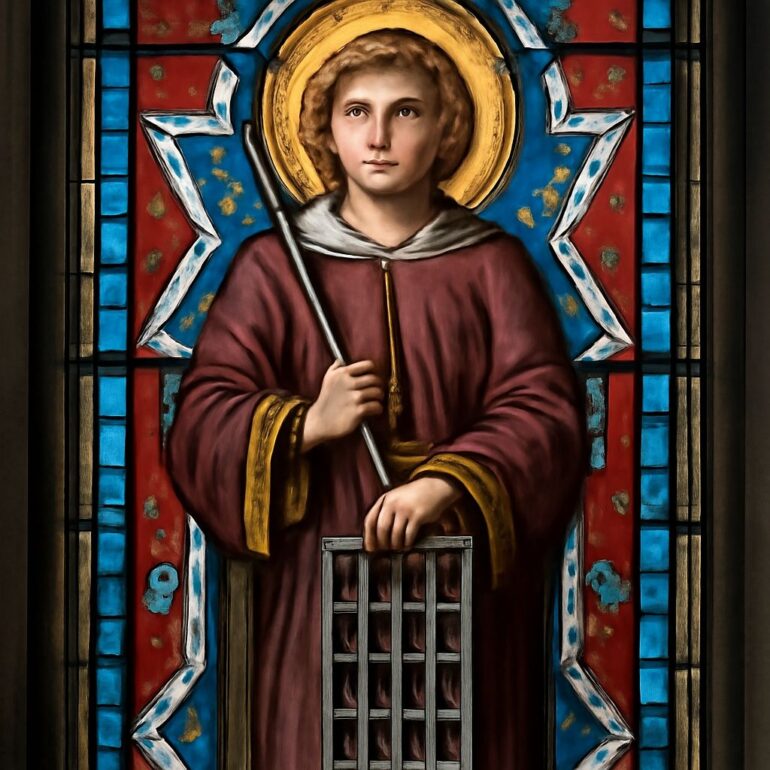
Lawrence was a deacon of the Church of Rome remembered as a martyr during the persecution under Emperor Valerian in 258. Early Roman commemoration places his burial on the Via Tiburtina and his feast on August 10. Later writers expanded his story with accounts of service to the poor and death on a gridiron.
The Roman martyr is also called Laurence in English and Lorenzo in Italian. Those names point to the same figure, but the sources for his life do not all belong to the same period. A fourth-century list of commemorations, a later sermon, and a work of art preserve different kinds of evidence.
Saint Laurence and the Church of Rome
A deacon is an ordained minister whose responsibilities in the early Church included service to the Christian community. Accounts of Lawrence connect his office especially with care for people in need and the administration of resources. The precise organization of third-century Roman church life should not simply be assumed to match the duties of a deacon in every present-day parish.
Saint Laurence is traditionally counted among the deacons serving Pope Sixtus II. In 258, during Valerian’s persecution, Sixtus and other clergy were killed. Lawrence’s death is remembered shortly afterward. The Vatican’s account for clergy describes this setting and distinguishes early testimony from later narratives containing legendary elements.
The context was a period of imperial action against Christian leadership and property. It helps explain why a deacon responsible for community resources became a central figure in later stories about the relationship between faith, wealth, and the poor. The historical circumstances and the later moral interpretation are related, but they are not identical kinds of evidence.
What the early record says
The Catholic Encyclopedia’s historical survey points to the Depositio Martyrum, a Roman list preserved in the Chronograph of 354. It records the August 10 commemoration and burial place on the Via Tiburtina. The list is evidence that Roman Christians remembered Lawrence and honored his grave by the fourth century; it is not a contemporary transcript of his trial.
The interval between 258 and the surviving written record matters. A later source may preserve an older tradition, but the date of the surviving source does not itself prove when every detail first circulated. For this martyr, historians compare the early calendar entry with accounts written decades later and with the development of the site of his burial.
A church was eventually built at the place associated with his grave, now the Basilica of San Lorenzo fuori le Mura, or St. Lawrence Outside the Walls. The name distinguishes its location outside Rome’s ancient walls. The growth of a pilgrimage church demonstrates the importance of his cult, meaning the public practices of remembrance and veneration surrounding him.
The poor as the Church’s treasure
One of the best-known accounts comes from Ambrose, bishop of Milan, writing in the late fourth century. He tells how Lawrence was asked for the Church’s treasures and presented people who were poor, ill, or otherwise in need. The story expresses a theological judgment: the community’s people and its duty of charity mattered more than precious objects.
Pope Benedict XVI retold this account in his 2005 encyclical Deus Caritas Est, presenting the deacon’s service to the poor as an example of Christian charity. Benedict treated the account as expressing an authentic picture of the saint. A historical reader can also observe that Ambrose wrote more than a century after the events and that the dialogue is not preserved in a third-century court record.
For Saint Lawrence, martyr and deacon, the story joins public witness to a practical obligation toward vulnerable people. It has remained influential because it gives a clear image to an institutional question: what should a church value and protect? Its force as a moral tradition does not depend on pretending that each quoted word can be independently verified.
The gridiron and the story of his death
The martyrdom of Saint Lawrence is frequently represented with a gridiron, a metal cooking grate. Ambrose and the poet Prudentius, writing in the late fourth and early fifth centuries, recount death by fire. Prudentius’s poetic account also supplies dramatic dialogue. These are important witnesses to a tradition circulating in their era, but they were written long after the persecution itself.
The familiar story that Lawrence asked to be turned over on the grate appears in later literary retellings of the event. It portrays courage and even humor in the face of death. The detail belongs to the history of the martyr’s remembered story; its presence in a sermon or poem should not be mistaken for a surviving eyewitness deposition.
The Vatican’s historical account acknowledges both the antiquity of the tradition and legendary elements in fuller narratives. A distinction can therefore be made between early commemoration of a Roman martyr and the later, richly detailed accounts of how he suffered.
How to recognize him in art
Artists commonly show Lawrence as a young deacon wearing a dalmatic, a liturgical garment with broad sleeves. He may carry a book, a palm branch associated with martyrdom, or a gridiron. The grate functions as an identifying attribute: a viewer who recognizes it can identify the saint even when the scene does not depict his death.
Images of the deacon distributing goods to poor people emphasize a different part of the tradition. They show charity as an act of ministry and often depict the recipients as the true treasure of the Church. The artist’s clothing, architecture, and setting may reflect the period in which the work was made rather than reconstructing third-century Rome.
A museum caption can identify the artist, date, and subject of an individual work. Those details answer different questions from the historicity of a scene. The gridiron is reliable evidence of an artistic convention; the image alone cannot establish the precise events of 258.
Feast and continuing devotion
The Catholic calendar celebrates the Roman deacon and martyr on August 10. His name also appears in the Roman Canon, the first Eucharistic Prayer of the Roman Rite, among saints remembered by the Church. A feast and a liturgical mention show the endurance of a community’s devotion over time.
Churches and institutions named for the deacon may emphasize different aspects of his memory: service, courage, liturgical ministry, or care for the poor. The English spellings Lawrence and Laurence, and forms in other languages, should be checked against the context. They can refer to other saints as well as the Roman martyr.
The early Roman calendar and burial tradition provide a starting point for his commemoration. Ambrose’s account, later narratives, and works of art show how that memory acquired vivid moral and visual forms. Reading them in sequence preserves both the early witness and the later interpretations that made it influential.
