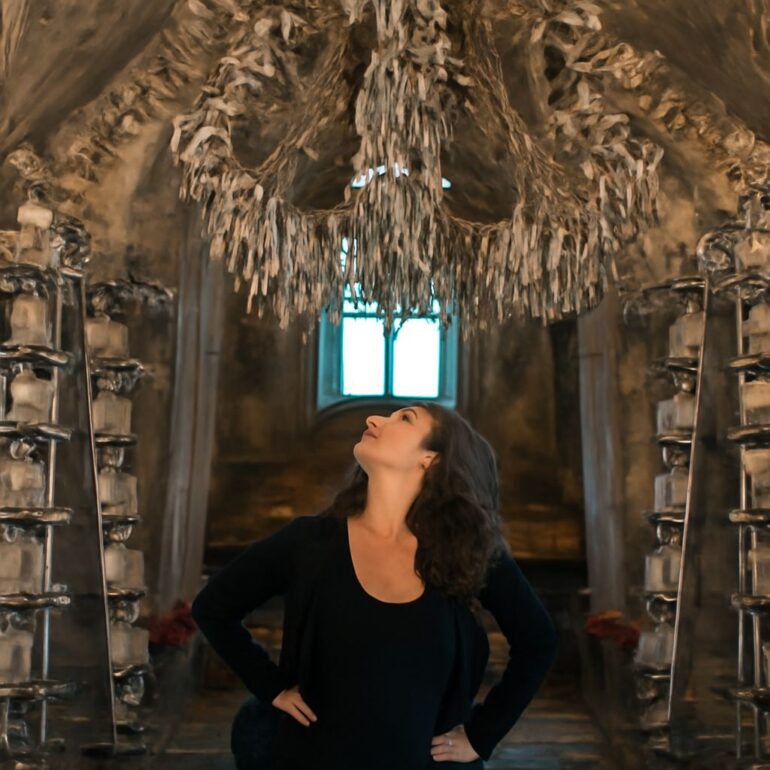
The church known for its bones in the Czech Republic is the Cemetery Church of All Saints at Sedlec, a district of Kutná Hora. Its lower chapel houses the Sedlec Ossuary, a place where human remains from the former cemetery were gathered and, in part, arranged into elaborate compositions.
The description of a church built from bones can obscure an important distinction: the building is a masonry church, while the remains form arrangements inside its lower chapel. The site grew out of a cemetery associated with a Cistercian monastery and remains a Roman Catholic sacred place. Its history joins burial practices, later artistic work, and continuing care for the dead.
Church Made of Bones: What the Name Describes
A church made of bones suggests that bones form the walls and roof. At Sedlec, the phrase describes the interior of an ossuary, a room or building used to hold human skeletal remains. The site’s history describes a two-level cemetery church: the lower chapel held remains, while the upper chapel was used for commemorative services.
The bone church Czech visitors know as Kostnice Sedlec stands within the historic cemetery, not beneath the larger Cathedral of the Assumption of Our Lady and Saint John the Baptist nearby. Both sites have connections to the former Cistercian abbey, but they are distinct buildings. A visitor looking for the famous arrangements should seek the Cemetery Church of All Saints and its lower chapel.
The distinction matters because the building and the display have different dates. The church is medieval; the familiar chandelier and other decorative features were made or reworked much later. The bones themselves came from many people buried at different times. Describing the site as a single artwork from one year conceals those layers of history.
The Monastery and Its Cemetery
The Cistercians are a Catholic monastic order whose communities combine religious life with work and prayer. A monastery was founded at Sedlec in 1142. According to the site’s account, it acquired wealth during the growth of silver mining in the area, and the nearby settlement developed into Kutná Hora. The cemetery served the community of the town and surrounding area over many generations.
A local tradition says that an abbot brought earth from the Holy Land and scattered it in the cemetery, increasing its appeal as a place of burial. The Sedlec history presents this account as a legend. It explains an important part of the cemetery’s reputation, but the legendary story should be distinguished from records of the monastery and the surviving building.
Population growth, disease, famine, and conflict placed pressure on burial space. When older graves were reopened to make room, remains could be gathered and kept in an ossuary. This practice connected the practical limits of a cemetery with a religious duty to care for the dead. The people whose bones are preserved here were individuals from the region, not anonymous material originally collected for an art project.
The regional tourism authority estimates that the remains of about 40,000 people were placed in the lower chapel. The regional account presents this as an estimate; an exact count of the people represented by the mixed remains should not be inferred from the visual scale of the arrangements.
From Cemetery Chapel to Ossuary
The site describes the church as likely built in the first half of the 14th century, while acknowledging that its exact construction date is uncertain. Its Gothic structure was connected to the cemetery’s work of burial and remembrance. The lower chapel provided a place for exhumed remains; the upper space served religious observances for the deceased.
The monastery and church suffered in the Hussite Wars in the 15th century. The site’s historical account says the church was probably damaged in 1421, and later repairs were undertaken over several periods. This qualified language matters: the existence of a medieval building does not mean that every visible element survived unchanged from its first construction.
A well-known story attributes the stacking of bones into pyramids to a half-blind monk in 1511. The regional account identifies that detail as a legend. The pyramids remain central to the visual organization of the lower chapel, but the story of their earliest arrangement should be presented as tradition rather than established personal biography.
Baroque Repair and a Nineteenth-Century Arrangement
At the turn of the 18th century, architect Jan Santini-Aichel was involved in repairs to the church and ossuary. The site considers him responsible for an early decorative concept in the lower chapel. Its account connects that work with Baroque religious ideas about death and hope for resurrection. Attribution and interpretation are presented by the site’s custodians; they are not a reason to assume that every object now visible dates from his work.
The Cistercian monastery was dissolved in 1783. The Schwarzenberg family later became patrons of the cemetery church and supported restoration. In the 19th century, František Rint worked on the skeletal decoration, completing the project in 1870. The site credits him with the chandelier, hanging garlands, and the Schwarzenberg coat of arms made from bones.
These compositions give the church of bones its recognizable appearance. Their forms can be examined as deliberate arrangements of human remains within an existing sacred building: a suspended chandelier draws the eye upward, while repeated skulls and long bones give other features a pattern. Their history is also a history of patronage and changing aesthetic choices, not a single medieval design preserved untouched. The family emblem links the display to those who supported its later restoration, while the arrangement of bones gives the emblem a material connection to the cemetery and its long use.
Death, Memory, and Sacred Space
The Latin phrase memento mori means “remember that you must die.” In a Christian setting, a reminder of mortality can accompany prayer for the dead and hope of resurrection. The site’s own interpretation contrasts the spiritual emphasis it associates with the earlier Baroque arrangement with the more dramatic effect of Rint’s later work. That is an interpretation of the display, and it helps explain how its caretakers understand its history.
A visitor may see an unusual work of craftsmanship, a burial place, and a religious space at once. None of those descriptions erases the others. The remains were once people with families and communities; the arrangements also reflect decisions by the people who cared for the site in later centuries. Respectful attention to both facts gives the chapel a fuller context than a description based only on surprise.
The Sedlec visitor guidance calls the ossuary a resting place and functioning sacred space and prohibits photography inside. Its directions and access arrangements can change, so visitors should check the official page before going. The nearby cathedral and the cemetery church each have their own histories, allowing a visit to place the ossuary within the wider story of the former abbey and the town.
