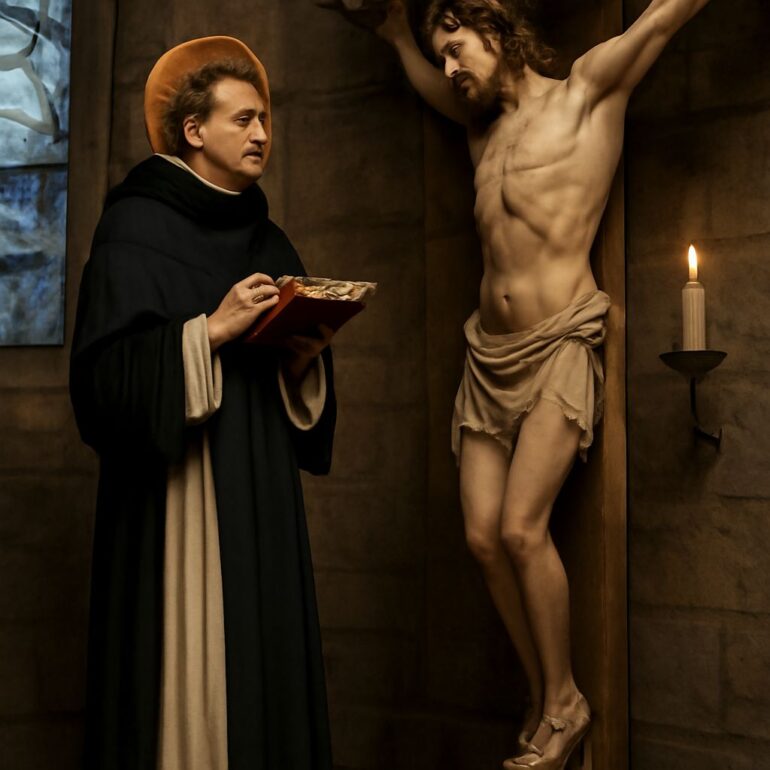
Thomas of Aquino, later honored as a saint, was a 13th-century Dominican friar, teacher, and author whose work joined Christian theological inquiry with sustained philosophical argument. He taught at a time when universities were taking shape and Latin scholars were studying newly available works of Aristotle.
His importance lies in both the questions he asked and the way he organized them. The Dominican saint Aquinas examined what reason can establish, what Christians know through revelation, and how human beings should live. His arguments continue to be studied by Catholic theologians and by philosophers who approach them from many perspectives.
Saint Thomas Aquinas and His Early Education
A useful thomas aquinas biography begins near Aquino in what is now Italy, around 1225. The Stanford Encyclopedia of Philosophy places his birth in a family connected with the castle at Roccasecca. As a child he studied at the Benedictine abbey of Monte Cassino, then continued his education in Naples. There he encountered the learning associated with Aristotle and met members of the Dominican order.
The Dominicans were a relatively new mendicant order: their friars combined communal religious life with preaching, study, and a commitment to poverty. Aquinas chose to join them rather than pursue the monastic path his family had expected. His family opposed the decision and detained him for a period. He eventually continued in the order and traveled north for further study.
At Paris and Cologne he studied with Albert the Great, a scholar interested in natural philosophy as well as theology. Medieval university teaching involved lectures, commentary on authoritative texts, and formal debate. These practices gave students a way to test a position against objections and competing interpretations. They also shaped Aquinas’s writing: a reader encounters not only a conclusion, but the questions and arguments that make the conclusion intelligible.
Teaching, Travel, and Final Years
Saint Thomas Aquinas taught theology in Paris and later worked in Dominican houses in Italy. He returned to Paris for a second period of teaching before moving to Naples in 1272. His career was therefore not confined to one university or to a single book. Teaching, preaching, biblical commentary, and debate formed the setting in which his larger works developed.
During his lifetime, Latin Christian scholars were engaging Greek philosophy through translations and through the work of Jewish and Muslim thinkers. Aristotle offered powerful tools for discussing nature, knowledge, and ethics, but his work also raised questions about how philosophical conclusions related to Christian doctrine. Aquinas drew on these sources while arguing for positions of his own; his work was part of an active conversation, not a simple transfer of ancient ideas into Christian language.
He stopped writing near the end of his life and died on March 7, 1274, at the abbey of Fossanova while traveling to the Second Council of Lyon. Accounts of his life include later stories whose details are difficult to verify. The Stanford entry distinguishes the reasonably secure chronology from those traditions and is a useful guide to the evidence.
The Summa and Other Major Works
The Summa theologiae is an extensive teaching work that Aquinas began for students of theology. It moves from God and creation to human action, virtues, Christ, and the sacraments. It remained unfinished at his death. Its scale can be intimidating, but each question is divided into shorter articles, so a reader can study a specific problem without reading the entire work in sequence.
A typical article begins with objections to a proposed answer, presents an opposing authority, states Aquinas’s own response, and then replies to the objections. The initial objections are positions he intends to address; they are not necessarily his final view. This structure is essential when a sentence is quoted from the work, since the same article can contain arguments on different sides.
His Summa contra gentiles considers truths about God, creation, and human destiny, with sustained attention to philosophical argument as well as Christian teaching. He also wrote biblical commentaries, disputed questions, and commentaries on Aristotle. These genres served different audiences and purposes. Reading them together shows a teacher engaging Scripture and a philosopher working carefully through inherited arguments, as well as the author of a systematic theological text.
Faith, Reason, and the Five Ways
For Aquinas, faith and reason are distinct ways of knowing that cannot ultimately contradict the truth. Reason works from what the human mind can understand; faith accepts divine revelation. He held that some truths, such as God’s existence, can be approached through rational argument, while mysteries such as the Trinity depend on revelation. Benedict XVI’s discussion offers a concise Catholic explanation of this distinction.
In the Summa theologiae, the famous “five ways” are arguments concerning God’s existence. One begins from change: things move from a potential state to an actual one, and Aquinas asks what explains such change. His reasoning depends on a wider account of causation and actuality; it is more precise than the slogan that everything must have a cause. The full article allows readers to examine the argument, its objections, and his replies in context.
The Dominican theologian also explored moral life in terms of human ends, habits, virtues, and law. A virtue is a stable disposition that helps a person act well. His account of natural law asks how practical reason recognizes basic goods and directs action toward them. These ideas have influenced later ethical and legal thought, while remaining subjects of substantial interpretation and criticism.
From Aquinas to Thomism
The question “who is thomas aquinas” has an answer that continues beyond his lifetime, but the later history should be kept distinct from his own career. The Catholic Church canonized him in 1323 and later recognized him as a Doctor of the Church, a title acknowledging the significance of his teaching. His writings became important resources for Catholic education and theology.
Thomism is the name given to traditions of interpretation and development drawing on his thought. Later thinkers worked in different settings and did not simply repeat one fixed system. As the Stanford entry explains, scholars such as John Capreolus and, later, Cajetan developed systematic interpretations after Aquinas had died. Modern scholars continue to debate how particular arguments should be understood and applied.
That distinction helps a reader evaluate a claim attributed to the saint. Is it found in his own text, in a commentator’s interpretation, or in a later school influenced by him? A reference to a particular question and article makes it possible to follow the argument and see how the claim fits its original purpose.
Where to Begin
For a reliable overview, start with the Stanford Encyclopedia’s life and works section, then read a single article of the Summa theologiae alongside its objections and replies. Question 2 on God’s existence is a well-known entry point; readers more interested in ethics can choose an article on virtue or law. This approach gives the reader both the historical setting and a direct encounter with the author’s method.
